
FORS Accreditation – What It Is, Why You May Need It and Why Your Whole Team Needs to Buy Into It
If you operate commercial vehicles, you’ve probably heard of FORS – the Fleet Operator Recognition Scheme.
Perhaps a customer has asked whether you’re FORS accredited.
Perhaps it’s appeared as a requirement for a contract or tender.
Or perhaps you’re looking at FORS because you want to demonstrate that you operate a safe, compliant, efficient and responsible fleet.
Whatever brought you to FORS, there’s one thing I think is really important:
FORS shouldn’t just be something the Transport Manager deals with once a year before the audit.
For it to work properly, the whole team needs to understand it and buy into it.
What is FORS?
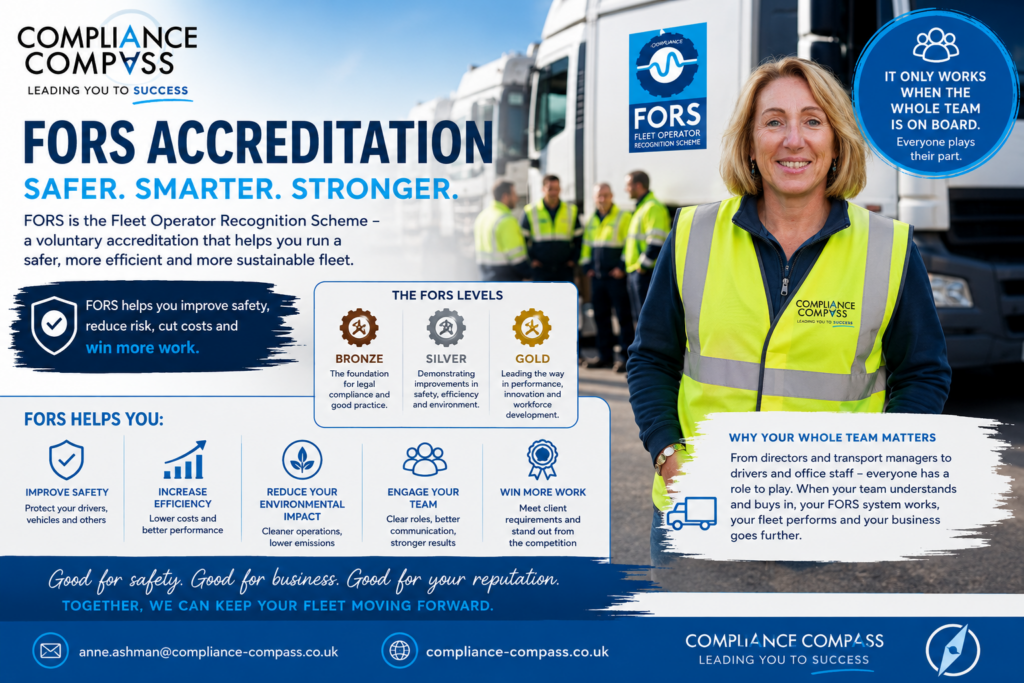
FORS is a voluntary accreditation scheme for fleet operators designed to improve standards across road transport. It assesses areas including safety, environmental performance and operational efficiency.
There are three levels:
Bronze – the foundation
The entry level, covering important areas including legal compliance, health and safety, driver management, vehicle maintenance, policies, procedures, training and environmental responsibility.
Silver – demonstrating improvement
Silver builds on Bronze and looks further at areas including fuel and emissions, collision data, vulnerable road users, environmental impact, training, subcontractor standards and fleet transition.
Gold – leading the way
The highest level, requiring operators to demonstrate continued improvement and leadership in areas such as safety, sustainability, operational performance and staff development.
But FORS is about much more than getting a sticker for your vehicles.
Why might your business need FORS?
Sometimes the simple answer is:
Because you need it to win the work.
Customers, principal contractors, construction projects and supply chains may specify a particular level of FORS accreditation as part of their procurement requirements. FORS itself says accreditation can provide access to major development projects where FORS is specified and can help operators win new business and retain existing customers.
That’s an important commercial reason.
But if you only look at FORS as something you need to win a contract, you’re missing a large part of its value.
FORS gives you a framework for looking properly at how your transport operation is being managed.
That means asking questions such as:
Are our drivers properly trained?
Are driving licences being checked?
Are vehicles inspected and maintained correctly?
Are defects being reported and rectified?
Are drivers’ hours and working time being managed?
Are accidents, incidents and near misses being investigated?
Are our policies actually being communicated?
Are we managing work-related road risk?
Are we monitoring fuel and environmental performance?
Are responsibilities within the transport operation clear?
Are we actually doing what our procedures say we’re doing?
The Transport Manager can’t do it alone
This is something I feel strongly about.
You can have a brilliant Transport Manager.
You can have every policy written.
You can have your FORS folders organised beautifully.
You can have your audit date in the diary.
But if the rest of the business doesn’t understand the system, there will be gaps.
FORS requirements themselves demonstrate how widely responsibility extends. They include defined roles and responsibilities, communication with drivers and transport-related staff, evidence that drivers have received and understood relevant information, and professional development for both drivers and managers.
So FORS can’t simply belong to one person.
Your drivers are a huge part of your FORS accreditation
The people driving your vehicles are the ones putting your policies and procedures into practice every day.
They’re completing vehicle checks.
They’re reporting defects.
They’re managing loads.
They’re dealing with customers and members of the public.
They’re making decisions on the road.
They’re representing your company every time your vehicle leaves the yard.
You can write the best driving standards policy in the world.
But if your drivers don’t know it exists, don’t understand why it matters or don’t follow it, the document isn’t protecting anyone.
FORS includes mandatory professional development requirements for drivers and managers because competence and awareness are fundamental parts of operating effectively.
And it goes beyond your drivers
Think about everyone who can influence your transport operation.
Directors and senior management need to support the system and provide appropriate resources.
Transport Managers and responsible persons need to maintain oversight and demonstrate effective management.
Drivers need to understand and follow the requirements that affect them.
Administration and operational teams may be responsible for maintaining records, checking documents, arranging training or monitoring compliance.
Workshop and maintenance providers can affect vehicle roadworthiness.
Suppliers and subcontractors may also need appropriate controls, particularly as you progress through the FORS levels.
That’s why I describe FORS as a whole-business approach to fleet management, rather than an audit exercise.
Don’t just prepare for the audit – prepare your business
One of the biggest mistakes you can make is waiting until the FORS audit is approaching before looking at your system.
Because the auditor isn’t simply interested in whether you can produce a policy.
You need evidence that things have actually been happening.
Records matter.
Communication matters.
Training matters.
Checks matter.
Reviews matter.
And evidence matters.
For example, FORS guidance for small operators identifies documented evidence requirements covering areas such as drivers’ hours, vehicle maintenance, driving licence checks, training and eyesight checks.
You can’t always recreate months of good management the week before an audit.
The best FORS preparation happens every day.
FORS can also help you run a better fleet
There is another side to FORS that shouldn’t be forgotten.
A safer, better-managed and more efficient fleet can also make commercial sense.
Looking closely at areas such as:
Fuel consumption.
Vehicle damage.
Collisions.
Maintenance.
Driver behaviour.
Emissions.
Route efficiency.
Training.
Subcontractor performance.
can potentially identify inefficiencies and unnecessary costs.
FORS states that the scheme is designed to improve road risk management, environmental impact and operational efficiency.
So again, this shouldn’t just be about passing an audit.
It should be about using the framework to make your operation better.
And this is where I fit in
Perhaps you’ve been told you need FORS for a contract and don’t know where to start.
Maybe you’re approaching your Bronze audit and aren’t confident that you have everything in place.
Perhaps you’re already FORS accredited, but maintaining all the documents, evidence, training and reviews has become difficult.
Or maybe your system has gradually become something that only gets attention when the audit date starts getting close.
That’s where I can step in.
I understand transport operations and compliance, so I don’t want to simply hand you a bundle of generic FORS documents.
I want to understand how your fleet actually operates.
I can help you look at what you already have, identify the gaps, organise the evidence, develop or improve your policies and procedures and make sure responsibilities are understood across the business.
Most importantly, I can help you turn FORS from something that one person is trying to maintain into something your team understands and participates in.
Because the sticker isn’t the goal
Of course you want to pass the audit.
Of course you want the FORS accreditation.
And if FORS helps you meet a tender requirement or win work, that’s important too.
But the real value comes when the principles behind that accreditation become part of everyday operations.
Safer drivers.
Safer vehicles.
Better records.
Clearer responsibilities.
Lower risk.
Better efficiency.
A stronger reputation.
And potentially more opportunities to win work.
That’s when FORS becomes more than a sticker on the vehicle.
It becomes part of how you run your business.
Need help with FORS?
Whether you’re starting your FORS journey, preparing for Bronze, progressing to Silver or Gold, or trying to get an existing FORS system back under control, I can help you identify what needs doing and put a practical plan in place.
Don’t wait until the audit is around the corner.
Get in touch and let’s have a chat about where you are now and where you need to be.
Anne Ashman | Compliance Compass
Leading You to Success
anne.ashman@compliance-compass.co.uk
compliance-compass.co.uk