
ISO 9001 Documentation Support: Practical Guide for UK SMEs
What if your ISO 9001 documentation was actually the engine that drove your business forward, rather than a heavy anchor holding you back? For many UK SMEs, the thought of an upcoming audit brings a specific kind of anxiety, often rooted in the fear of missing paperwork or drowning in folders of unnecessary fluff that nobody ever reads. Accessing the right ISO 9001 documentation support can change this experience entirely. It’s about moving away from confusion over documented information and towards a system that actually works for your team.
We understand that you want a Quality Management System that adds value and makes you contract-ready for larger supply chains, not just something that ticks a box. This guide will show you how to navigate the requirements of the 2015 standard and prepare for the upcoming 2026 revision with total confidence. You’ll learn how to strip away the bureaucracy and focus on the records that truly matter to UKAS auditors. We’ll outline a practical, step-by-step approach to building a streamlined system that secures your business’s future and proves your commitment to excellence.
Key Takeaways
- Clarify the transition from separate documents and records to the unified “documented information” requirement to simplify your management system.
- Pinpoint the exact mandatory documents and records you need to stay compliant and avoid common pitfalls during a UKAS audit.
- Streamline your processes by applying the requirements of Clause 7.5 in a way that suits a smaller enterprise without adding unnecessary fluff.
- Discover how practical ISO 9001 documentation support helps you build a system that reflects your actual business activities rather than just chasing a standard.
- Learn how a professional gap analysis identifies missing links in your paperwork, making your firm contract-ready for high-value supply chains.
Understanding ISO 9001 Documented Information
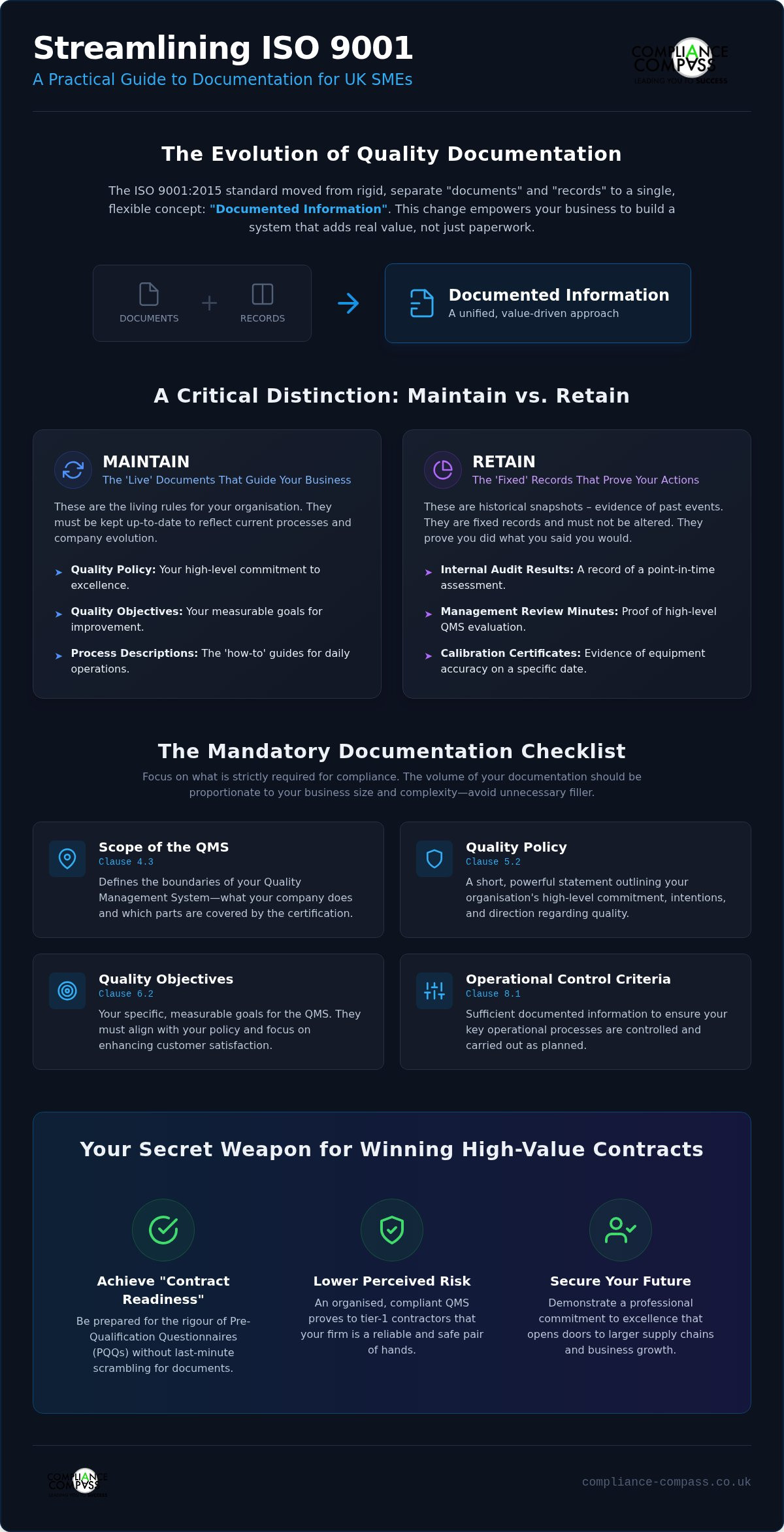
Within the ISO 9000 family of standards, the term “documented information” refers to any data that an organisation must control and maintain. It’s a broad definition that covers everything from digital files and cloud based software to traditional paper manuals. Since the 2015 revision, ISO 9001 documentation support has focused on this unified concept, which replaced the older, more rigid distinction between “documents” and “records”. This shift was designed to give businesses more flexibility in how they prove their quality management works, focusing on what’s necessary for the business rather than just filling folders.
For a small business, this documentation serves two vital roles. First, it provides a clear framework for daily operations, ensuring everyone knows exactly how tasks should be performed. Second, it acts as a permanent trail of evidence to show that these processes actually happened. By establishing a “single source of truth”, you reduce the operational risk of relying on the memory of one or two key employees. If someone is away from the office, the business doesn’t grind to a halt because the “how-to” is already captured, accessible, and standardised.
Why Documentation is Your Secret Weapon for Tenders
Robust documentation proves to tier-1 contractors that your firm is a safe pair of hands. In the 2026 business landscape, “contract readiness” is the standard for UK SMEs looking to secure high-value work. When you can present an organised, compliant Quality Management System, you immediately lower the perceived risk for a potential client. Professional ISO 9001 documentation support ensures you’re prepared to face the rigour of Pre-Qualification Questionnaires (PQQs) without the usual last minute scramble. Instead of searching for evidence of your quality controls, you can provide clear, professional proof that your business is reliable and ready for growth.
The Difference Between Maintaining and Retaining
A common hurdle during audits is the confusion between maintaining and retaining information. Maintaining documented information refers to the “live” documents that guide your business. These include your quality policy, objectives, and process descriptions. You must keep these up to date as your company evolves. Retaining documented information, however, involves keeping records of past events. This includes things like internal audit results, management review minutes, and calibration certificates. Confusing these two leads to non-conformities; you can’t “maintain” an audit report from last year because it’s a fixed record of a specific moment in time. Getting this right is a simple way to build auditor confidence from the start.
The Essential List: Mandatory ISO 9001 Documents and Records
Navigating the mandatory requirements of the standard doesn’t have to mean drowning in paperwork. Many businesses fall into the trap of over-complicating their systems, but the official ISO 9001 guidance actually encourages a lean approach. The volume of your documentation should always be proportionate to the size and complexity of your business. Accessing expert ISO 9001 documentation support helps you distinguish between what is strictly required for compliance and what is simply “filler” that adds no value to your operations.
Whilst the 2015 update removed the strict requirement for a formal Quality Manual, it remains a best practice for many UK firms. It acts as a helpful “map” for both your team and your UKAS auditor, showing how different processes link together. If you’re unsure whether your current paperwork meets the grade, a professional gap analysis can quickly identify any missing links before they become an issue during an audit.
Mandatory Documents: The “Rules” of Your Business
These are the foundational documents that define how your Quality Management System (QMS) operates. You must maintain these to ensure consistency across the firm:
- Scope of the QMS (Clause 4.3): Think of this as the “fence” around your business. It defines exactly what your company does and which parts of the organisation are covered by the certification.
- Quality Policy (Clause 5.2): This is your high-level commitment to quality. It’s a short, powerful statement that outlines your intentions and direction.
- Quality Objectives (Clause 6.2): These are your measurable goals. They must be consistent with your policy and focused on enhancing customer satisfaction.
- Operational Control (Clause 8.1): You need enough documentation to ensure your processes are carried out as planned. This sets the standard for employee behaviour and performance.
Mandatory Records: The “Proof” of Your Compliance
Records are the evidence that your rules are being followed. Without these, an auditor has no way to verify that your processes actually work. You must retain:
- Monitoring and Measuring Equipment Calibration (Clause 7.1.5.1): If you use tools to verify your products or services, you must keep records of their calibration or verification.
- Evidence of Competence (Clause 7.2): You need proof that your staff have the right skills and training for their roles. This includes training logs and certificates.
- Management Review Results (Clause 9.3): These records prove that your senior leadership is actively involved in the QMS and looking for ways to improve.
- Internal Audit Results (Clause 9.2): You must keep records of your internal checks to show you are identifying and fixing issues yourself.
Navigating Clause 7.5: Creation, Update, and Control
Clause 7.5 often feels like the most bureaucratic part of the standard, but it’s simply about keeping your house in order. It ensures that your team isn’t working from outdated instructions or lost in a sea of nameless files. Effective ISO 9001 documentation support helps you build a system where the right people have the right information at the right time. Whilst many firms worry about the complexity of these requirements, they essentially boil down to three manageable stages: general requirements, the creation process, and ongoing control.
For a small business, “appropriate identification and description” doesn’t require a complex coding system. It means giving every document a clear title, a date, and a version number. Before any document is released, it must undergo a review and approval process. This isn’t just a box-ticking exercise; it’s a check to ensure the document is actually suitable and adequate for its intended purpose. If you’re aiming for BSI ISO 9001 certification, having a clear trail of who approved what will be one of the first things an auditor looks for.
To manage this effectively, we recommend a simple 4-step framework for controlling your information:
- Distribution: Ensure the document reaches the people who actually need it.
- Access: Make it easy to find, whether that’s on a shared drive or a physical folder.
- Retrieval: Have a logical filing system so you can pull up evidence quickly during an audit.
- Use: Check that the document is being followed correctly in daily operations.
Creating and Updating with Clarity
Consistency is king when it’s time to update your procedures. We suggest standardising your formats by using a simple header on every page that includes the document name, author, and current version. Don’t fall into the trap of using overly academic language or “management-speak”. If the person on the shop floor can’t understand the instructions, the document has failed its purpose. Keep your language direct and action-oriented. Version control is your best defence against mistakes; it prevents the “Draft_Final_v2” nightmare by ensuring only the latest, approved procedure is available for use.
Controlling Information: Access and Protection
Your system must also account for “Documented Information of External Origin”. These are things like client-supplied drawings, industry regulations, or British Standards that you don’t write yourself but must follow. You need to identify these and control their distribution just as carefully as your internal policies. Access is equally about protection. Whilst staff need to see procedures, sensitive records must be kept confidential and secure. For digital systems, this means regular backups and password protection are non-negotiable. Using professional ISO 9001 documentation support ensures these security measures are practical and don’t hinder your team’s efficiency.
Overcoming Documentation Overload: SME Best Practices
Many business owners believe that a thick folder of procedures is the hallmark of a successful Quality Management System (QMS). In reality, a bloated system is often a sign of inefficiency. Your documentation should act as a clear reflection of your actual business activities, not a direct copy of the standard’s text. This is where practical ISO 9001 documentation support becomes invaluable. It helps you avoid the “Documentation Trap”, which is the dangerous habit of creating paperwork for processes your team doesn’t actually perform just to satisfy a perceived requirement.
Instead of building a separate, isolated world for your ISO records, integrate them into the tools you already use. If your team manages projects through a CRM or specific server folders, keep your quality records there. Using internal links within your digital documents allows staff to find information instantly, reducing the friction that often leads to people ignoring the system altogether. A pragmatic mentor approach ensures that your QMS feels like a natural part of the working day, not an administrative burden added on top. Understanding the broader ISO certification journey for SMEs can help you see how documentation fits into the wider roadmap to achieving and maintaining your certification.
Right-Sizing Your QMS
A 50-page procedure for a five-person team is almost always a sign of a failing system. If a process can be explained with a simple flowchart or a two-minute video, use those instead of dense paragraphs of text. Auditors actually prefer these visual aids because they are easier for staff to follow and harder to misinterpret. Right-Sizing is the process of ensuring documentation complexity matches operational risk. By focusing on high-risk areas and keeping low-risk instructions brief, you create a system that staff actually value. If your current paperwork feels overwhelming, our team can provide the ISO 9001 support needed to trim the fat and focus on what matters.
Common Pitfalls and How to Avoid Them
One of the most frequent mistakes is “Auditor-Pleaser” syndrome. This happens when you write procedures specifically because you think the auditor wants to see them, even if they don’t fit your business model. This creates a disconnect that often leads to non-conformities during the actual audit. Another significant risk is the use of obsolete documents. When old versions of a process are left in circulation, costly mistakes are inevitable. To prevent this, maintain a simple Master Document Register. This acts as a single, organised list that tracks the current version and location of every essential document, ensuring everyone is always working from the same, approved information.
Professional ISO 9001 Documentation Support: A Safe Pair of Hands
Establishing a Quality Management System is a significant milestone, but maintaining it whilst managing daily operations is where many UK SMEs feel the pressure. Anne Ashman’s Compliance Compass acts as a pragmatic partner, offering the hands-on assistance needed to keep your system moving forward. We don’t just provide high-level advice; we work alongside you to ensure your paperwork is accurate, organised, and useful. Our ISO 9001 documentation support begins with a thorough Gap Analysis. This process identifies exactly which pieces of documented information are missing or incomplete, preventing you from wasting time on unnecessary “fluff” and focusing your energy where it matters most.
The ultimate goal of this partnership is to move your business from being merely compliant to being truly competitive. In the modern supply chain, being “contract-ready” is essential for winning tenders with larger organisations and tier-1 contractors. By ensuring your documentation is robust and professional, you remove the barriers to growth and project a sense of calm confidence to potential clients. We take the administrative burden off your shoulders, allowing you to focus on the core activities that drive your revenue.
The Value of an ISO 9001 Readiness Review
Think of a readiness review as a final safety net. Before your official UKAS audit, a professional check of your system can identify potential “Major Non-Conformities” that might otherwise lead to a failed assessment. This service provides the reassurance that your documentation is not only present but also effective. Because we understand the broader landscape of business standards, this review also helps align your processes with other requirements, such as ISO 14001 or Constructionline. It’s about building a solid foundation that supports multiple certifications without duplicating the effort.
Outsourced Support: More Than Just a Consultant
Many small firms lack a dedicated Quality Manager, which often leads to documentation becoming outdated or ignored. Anne Ashman’s Compliance Compass can fill this gap by acting as your outsourced Quality Manager. We handle the repetitive but vital tasks, such as updating the Master Document Register and tracking internal audit results. Our approach is holistic; we look at how your QMS can integrate with other essential business functions like HR support and bookkeeping. This creates a streamlined, cohesive system where information flows logically between departments. Speak to Anne Ashman today about your ISO 9001 documentation support to find out how we can simplify your path to certification and beyond.
Build a QMS That Works for Your Growth
Navigating the complexities of documented information doesn’t need to be a source of stress for your team. By focusing on mandatory requirements and right-sizing your system to match your actual operations, you transform a bureaucratic hurdle into a powerful business asset. Your documentation should provide a clear framework for daily work and solid evidence of your results. This approach helps you move from simply being compliant to becoming truly competitive in the UK market.
Accessing professional ISO 9001 documentation support ensures your system is lean, effective, and prepared for the rigours of a UKAS audit. Anne Ashman and the team at Compliance Compass specialise in providing pragmatic, hands-on assistance that makes SMEs contract-ready. As experts in ISO 9001, 14001, and 45001, we act as a safe pair of hands for your business management needs. We understand the daily pressures you face and work to remove the barriers to your operational success.
Get your ISO 9001 documentation audit-ready with Compliance Compass and take the first step towards securing larger supply chain contracts with total confidence. You’ve built a great business; let’s ensure your systems prove it to the world.
Frequently Asked Questions
Is a Quality Manual mandatory in ISO 9001:2015?
A formal Quality Manual is no longer a mandatory requirement under the ISO 9001:2015 standard. However, many UK SMEs find that maintaining one provides a helpful roadmap for employees and auditors alike. It acts as a central hub that explains how your processes connect. Whilst you won’t be penalised for not having one, it remains a best practice for demonstrating a high level of organisation and clarity within your Quality Management System.
How long do I need to retain ISO 9001 records for?
Retention periods are not explicitly defined by ISO 9001; instead, they should be determined by your specific legal, regulatory, and customer requirements. Most UK businesses choose a standard period of three to seven years for quality records. For example, financial records often require six years for HMRC purposes. It’s vital to document these retention times in your control procedure to ensure consistency and avoid cluttering your storage with obsolete data.
Can I use digital signatures for document approval?
You can certainly use digital signatures for document approval within your QMS. ISO 9001 is medium-neutral, meaning it doesn’t matter if your approvals are physical stamps, handwritten signatures, or digital timestamps in a cloud based system. The key is ensuring that the approval method is secure, identifiable, and consistently applied. Digital signatures often improve efficiency for remote teams by removing the need for scanning and printing physical paperwork during the review process.
What happens if an auditor finds a document is out of date?
If an auditor finds an obsolete document in use, they will typically issue a minor non-conformity. This isn’t a “fail” but a signal that your document control process needs tightening. You’ll be required to show how you’ve corrected the error and what steps you’ve taken to prevent it from happening again. Professional ISO 9001 documentation support helps you build a Master Document Register to ensure your team always accesses the latest versions.
Do I need to document every single process in my business?
You don’t need to document every single task performed in your business. The standard requires documentation only where it’s necessary to ensure the effective planning, operation, and control of your processes. Focus on high-risk activities where a mistake would directly impact product quality or customer satisfaction. Over-documenting simple, low-risk tasks leads to the “paperwork fluff” that often slows down SMEs and makes the system much harder to maintain in the long run.
How do I manage documentation if I have a remote workforce?
Managing documentation for a remote workforce is best handled through a secure, cloud based management system or a shared server. This ensures that everyone has real-time access to the most recent procedures regardless of their location. You should establish clear protocols for digital access, version control, and secure storage. Providing remote staff with tailored ISO 9001 documentation support ensures they remain compliant and connected to the company’s quality objectives without needing to visit a central office.
Can I integrate ISO 9001 documentation with ISO 14001 and 45001?
Integrating ISO 9001 with ISO 14001 and ISO 45001 is a highly efficient strategy for UK SMEs. Since these standards share a common high-level structure, you can create a single Integrated Management System. This allows you to use one set of procedures for common requirements like internal audits, management reviews, and document control. Integration reduces administrative duplication, saves time during audits, and provides a more holistic view of your business’s overall performance and risk.
What is the best way to control “External Origin” documents like British Standards?
The best way to control external origin documents is to include them in your Master Document Register. You must identify these documents and ensure their distribution is controlled so that staff don’t use outdated versions. We recommend checking for updates to external standards at least once a year. Keeping a clear record of where these documents are stored and who has access to them is essential for maintaining audit readiness and operational consistency.
Disclaimer
This article is for general information only and does not constitute legal, financial or professional advice. Requirements may vary, so please seek advice appropriate to your circumstances. AA Compliance Compass Ltd accepts no liability for actions taken based on this content.