Business Process Improvement: UK SME Framework 2026
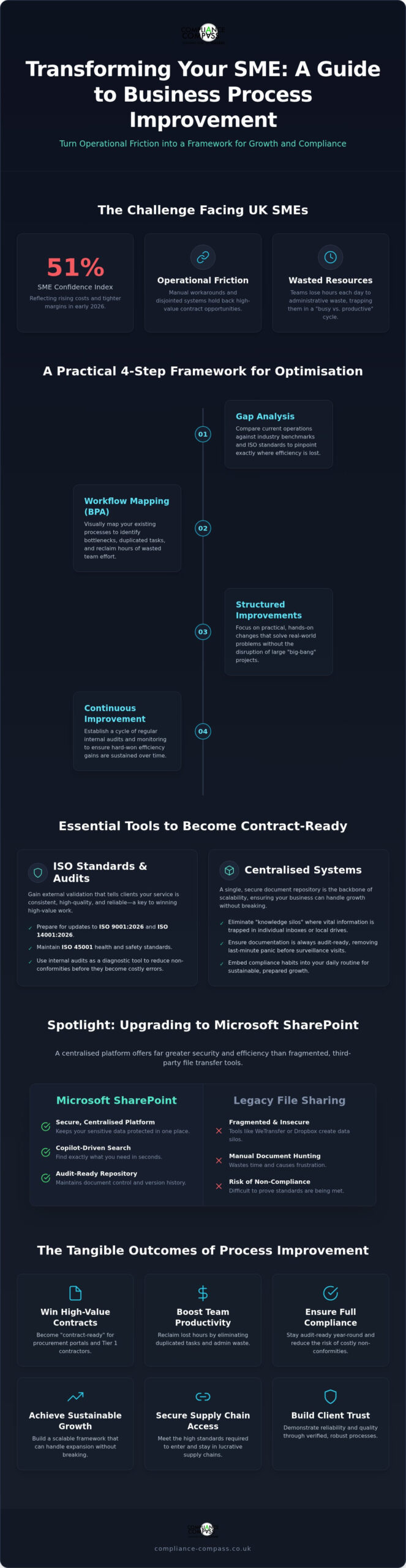
With the SME Confidence Index dipping to 51% in early 2026, many UK business owners feel the weight of rising costs and tighter margins. You’re likely tired of seeing your team lose an hour every day to admin waste or feeling the sting of a rejected tender because manual document systems aren’t up to scratch. It’s frustrating when operational friction holds you back from the high-value contracts you deserve. This guide shows you how to implement business process improvement for SMEs to transform that friction into a streamlined, audit-ready framework. You’ll learn how to navigate the 2026 updates to ISO 9001 and ISO 14001, turning complex regulatory requirements into a clear path for growth. We’ll explore how to build a centralised system that secures your place in lucrative supply chains while finally freeing your team to focus on work that matters.
Key Takeaways
- Moving beyond the “busy vs productive” trap starts with a clear definition of business process improvement for SMEs as a tool for risk reduction and efficiency.
- A structured gap analysis identifies where your current operations fall short of industry benchmarks, providing a logical starting point for meaningful change.
- Mapping your workflows helps you spot where tasks are snagging or being duplicated, allowing you to reclaim lost hours and boost team output.
- Adopting ISO standards and centralised business systems transforms your internal documents into an audit-ready asset that helps you win high-value contracts.
Beyond Theory: Why British SMEs Need Compliance-Led Process Improvement
True business process improvement for SMEs isn’t just a corporate buzzword. It’s the systematic identification of operational gaps to reduce risk and increase productivity across every department. Many British firms currently fall into the “busy vs productive” trap. Your team might work flat out, yet your overall output remains stubbornly stagnant because your workflows are cluttered with manual workarounds. By adopting business process management principles, you can stop the cycle of daily “firefighting” and build a foundation for genuine growth.
Traditional academic models often fail smaller firms because they’re too clinical or detached from the reality of a busy workshop or office. You don’t need a 200-page theory manual. You need a practical, hands-on approach that addresses immediate friction and removes barriers. This shift from abstract theory to tangible practice is vital for UK businesses aiming to become “contract-ready.” In the competitive B2B sector, process excellence is no longer a luxury; it’s the essential price of entry for high-value partnerships. Integrating your essential functions into a bespoke business support plan is one of the most effective ways to align your operations and reduce the risk of falling behind on compliance.
From Operational Friction to Contract-Ready Status
Robust processes form the foundation for winning work through competitive procurement portals like Constructionline. Major organisations and Tier 1 contractors demand documented proof that you meet high standards in health, safety, and quality before they’ll even consider your bid. If your internal systems are fragmented, you risk being excluded from lucrative supply chains. Using business process improvement for SMEs ensures your documentation is always audit-ready. Independent reviews are often the missing piece in this puzzle. They provide the objective, expert perspective needed to unstick long-standing bottlenecks that your internal team might have simply accepted as “the way things are.”
A Practical Framework for Mapping and Optimising SME Workflows
To achieve meaningful business process improvement for SMEs, you must move away from guesswork. Start with a comprehensive gap analysis. This compares your current operations against industry benchmarks or ISO standards to reveal exactly where you’re losing efficiency. Next, use Business Process Analysis (BPA) to map out your existing workflows. This visual exercise identifies where work is “snagging” or being duplicated across your team, often uncovering hours of wasted effort. Instead of launching expensive, “big-bang” IT projects that often over-promise, focus on structured, hands-on improvements. These practical changes solve real-world problems without disrupting your daily flow. Finally, establish a cycle of continuous improvement through regular reviews and internal monitoring to ensure these gains stick. This structured approach to business process improvement for SMEs turns chaotic tasks into a predictable, manageable framework.
Leveraging Internal Audits to Identify Systemic Gaps
Think of internal audits as a vital diagnostic tool for your business health. These reviews are essential for preparing your organisation for the transition to ISO 9001:2026 and ISO 14001:2026, whilst maintaining ISO 45001 standards. Under Document Version 001, dated 7/7/2026, a robust management system must focus on reducing non-conformities before they become costly errors. This proactive step ensures your processes remain lean and ready for external scrutiny. For those looking to unearth hidden inefficiencies, an independent review provides the clarity needed to move forward with confidence.
Scaling Operations through Robust Business Systems and ISO Standards
Scaling your business requires more than just increased sales; it demands a structure that can handle growth without breaking. Implementing business process improvement for SMEs provides the framework for this expansion. Achieving ISO support validates your internal improvements to the outside world. It tells prospective clients that your service is consistent, high-quality, and reliable. This external validation is a powerful tool for securing high-value contracts that might otherwise be out of reach for a smaller firm.
A centralised document repository is the backbone of this scalability. Without one, your team risks falling into “knowledge silos” where vital information is trapped in individual inboxes or local drives. Regular process analysis ensures you stay audit-ready year-round. This removes the frantic, last-minute panic often associated with surveillance visits. By embedding these habits into your daily routine, you create a business that is always prepared for scrutiny and primed for sustainable growth. Many SMEs find that consolidating their HR, bookkeeping, and compliance functions under a single bespoke business support plan is the most practical way to achieve this level of operational resilience.
Centralising Document Control with Microsoft SharePoint
Managing your compliance documents shouldn’t feel like a chore. Implementing SharePoint business systems provides a secure, centralised platform for your Word, Excel, and PowerPoint files. Within the Microsoft 365 ecosystem, Copilot-driven search eliminates the frustration of manual document hunting. You can find exactly what you need in seconds. This approach offers far greater security than relying on fragmented third-party file transfer tools like WeTransfer or Dropbox. An audit-ready repository keeps your sensitive data protected whilst ensuring your team always works from the most recent version. This level of organisation is a core component of effective business process improvement for SMEs, providing the stability needed to scale with confidence.
Building Your Path to Operational Excellence in 2026
Implementing business process improvement for SMEs isn’t a one-off project; it’s a strategic commitment to smarter working. By replacing fragmented manual workflows with centralised, audit-ready systems, you reclaim valuable hours and eliminate the constant worry of non-conformities. Aligning your operations with the 2026 ISO updates does more than satisfy regulatory requirements. It transforms your business into a contract-ready organisation capable of winning high-value tenders in competitive supply chains.
With over 15 years of industry experience, we understand the specific pressures of running a smaller firm. We specialise in providing the practical ISO and tender accreditation support you need to scale with confidence. We’re dedicated to being your safe pair of hands, Leading You To Success by simplifying the complex and removing the barriers to your growth.
Contact AA Compliance Compass Ltd today to organise a professional gap analysis for your SME
Frequently Asked Questions
What is the difference between business process improvement and a gap analysis for SMEs?
A gap analysis is the diagnostic starting point that compares your current operations against industry standards or ISO benchmarks. In contrast, business process improvement for SMEs is the broader, systematic journey of refining those workflows to reduce risk and boost output. It’s helpful to view the gap analysis as the tool that identifies the holes, whilst process improvement is the actual work of building the bridge.
How long does it typically take to see results from process optimisation?
You’ll often see immediate results by reclaiming administrative time previously lost to manual workarounds. Initial quick wins from mapping workflows don’t take long to appear, often surfacing within the first few weeks as bottlenecks are cleared. Long-term outcomes, such as becoming audit-ready for major contracts, typically solidify over several months. This happens as your team adopts new, streamlined habits and moves away from inefficient legacy systems.
Can business process improvement help my SME achieve ISO 9001 certification?
Business process improvement for SMEs is the primary vehicle for achieving ISO 9001 certification. It’s what ensures your quality management system is robust, documented, and consistently applied across your organisation. By refining your processes to meet these international standards, you’ll reduce the likelihood of non-conformities during audits. This preparation validates your high standards to external stakeholders and helps you secure lucrative tenders with confidence.
Why should SMEs avoid using third-party file transfer tools for compliance documents?
Third-party tools often lack the integrated security and version control required for strict compliance. Using a centralised SharePoint-based system ensures your sensitive documents remain within a secure, audit-ready repository. It doesn’t just store files, as it also secures them against unauthorised access. This prevents knowledge silos and ensures your team always accesses the most recent version, eliminating the risk of data being stored on external, unmanaged servers.
Disclaimer
This article is for general information only and does not constitute legal, financial or professional advice. Requirements may vary, so please seek advice appropriate to your circumstances. AA Compliance Compass Ltd accepts no liability for actions taken based on this content.