
Could Your Business Run If a Key Manager Was Unexpectedly Absent?
If you or a key member of staff had to step away from your business tomorrow, could someone else keep things running?
Would they know how to complete work activities, find the right information and make decisions? Or would essential knowledge leave the business with the person who is absent?
ISO 9001, ISO 14001 and ISO 45001 provide a framework for managing quality, environmental responsibilities and health and safety. Implementing these standards gives you an opportunity to build a management system that captures how your business operates and helps others take over when needed.
That is where a practical integrated management system (IMS) manual can add real value.
What should your ISO management system do?
Your ISO management system should help you organise, control and improve the way your business works.
It should connect customer requirements, operational processes, risks, responsibilities and performance checks. People should understand what needs to happen, how to carry out their work and what to do when something goes wrong.
Used effectively, the system helps you deliver consistent work, manage environmental impacts and control health and safety risks. Clear processes also reduce reliance on one person remembering every task or making every decision.
The value comes from building the standards into your business activities. Not just letting it be an expensive certificate on the wall.
Build your IMS manual from the standards and your business processes
Developing an IMS gives you the chance to bring your business knowledge into one accessible framework.
You can use the requirements of ISO 9001, ISO 14001 and ISO 45001 to examine how your business operates:
- What processes do you need?
- How do those processes connect?
- Who carries out each activity?
- What risks and controls must they understand?
- Which instructions and records are needed?
- How do you check that work has been completed correctly?
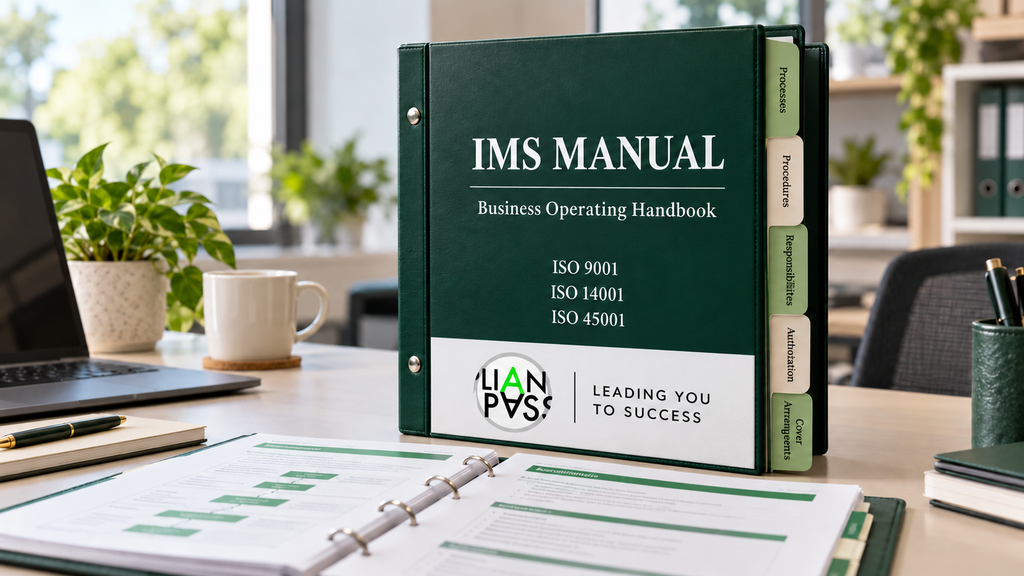
Your IMS manual can then act as your business operating handbook, explaining the system and directing people to the procedures, systems, forms and records they need.
The standards do not require a document specifically called an “IMS manual”, or a written procedure for every activity. However, you need the documented information required by the applicable standards, together with the information necessary to operate and control your processes effectively.
This gives you scope to create a system that suits your business, its people and the complexity of its work.
Produce procedures that someone else can follow
When developing your procedures, consider whether an appropriately trained person could use them to take over an activity.
An instruction such as “process the customer order” may mean very little to someone providing cover. They may need to know where the order is recorded, which checks are required, who approves it and how it moves into delivery.
Depending on your business, useful procedures may cover:
- Customer enquiries, quotations, orders and contract reviews.
- Planning, delivering and checking products or services.
- Purchasing and supplier or subcontractor approval.
- Environmental controls and waste management.
- Health and safety assessments and safe working arrangements.
- Training, competence and access to business systems.
- Complaints, incidents and corrective actions.
- Document control, internal audits and performance reviews.
The aim is to capture enough practical detail for work to continue consistently and safely. Instructions should be current, easy to find and clear about when further advice or approval is needed.
Include responsibilities and authorisation levels
A procedure becomes much more useful when it explains both who does the work and who can approve decisions.
Someone covering an absence may understand how to raise a purchase order but still need to know how much they can spend. They may be able to prepare a quotation without authority to agree a discount or accept a contract.
Your IMS should make these boundaries clear through defined responsibilities and, where useful, an authorisation matrix covering:
- Purchasing and expenditure limits.
- Quotations, discounts and contract acceptance.
- Supplier and subcontractor approval.
- Approval and release of completed work.
- Changes to procedures and operational arrangements.
- Escalation of quality, environmental and safety concerns.
Include who provides cover and how approval is obtained when the usual decision-maker is unavailable.

Test whether your system supports an unexpected absence
A useful question during an ISO internal audit or gap analysis is:
“If the person who normally does this job were unexpectedly absent, could a competent colleague find what they need and carry on?”
Ask that colleague to walk through the process. Can they locate the current procedure, access the relevant records and identify their approval limits?
This can reveal missing instructions, unclear ownership or access arrangements that depend on one person.
Your IMS can support continuity, alongside suitable training, cover arrangements and contingency planning. A manual becomes valuable when people can use it in practice.
How AA Compliance Compass can help
At AA Compliance Compass Ltd, I combine lead auditor experience with practical experience as a commercial and operations director who has built and implemented ISO management systems within a working business.
I help you use the standards to develop a practical system around your operations, capturing essential knowledge, clarifying responsibilities and producing procedures that support your team.
Through IMS development, ISO internal audits, gap analysis and implementation support, I work with businesses in Derbyshire and across the UK to make their management systems useful every day.
Explore our ISO and accreditation support or contact Anne.ashman@compliance-compass.co.uk.
Your ISO system should be more than an expensive certificate on the wall. It should help your team keep the business running when someone unexpectedly has to step away.
A practical cover test
Imagine the person who normally approves customer quotations is unexpectedly absent for a week. Ask the nominated cover person to find the latest pricing, check a customer’s requirements and identify who can approve an exception. If they cannot complete those steps without ringing the absent manager, record each gap and agree an owner to fix it. Test the revised arrangements with another quotation before relying on them.
If this sounds familiar, call me on 07889 890234. I can complete a practical gap analysis and give you a prioritised action plan.