
Government Loan Support for UK SMEs: The 2026 Eligibility and Preparation Checklist
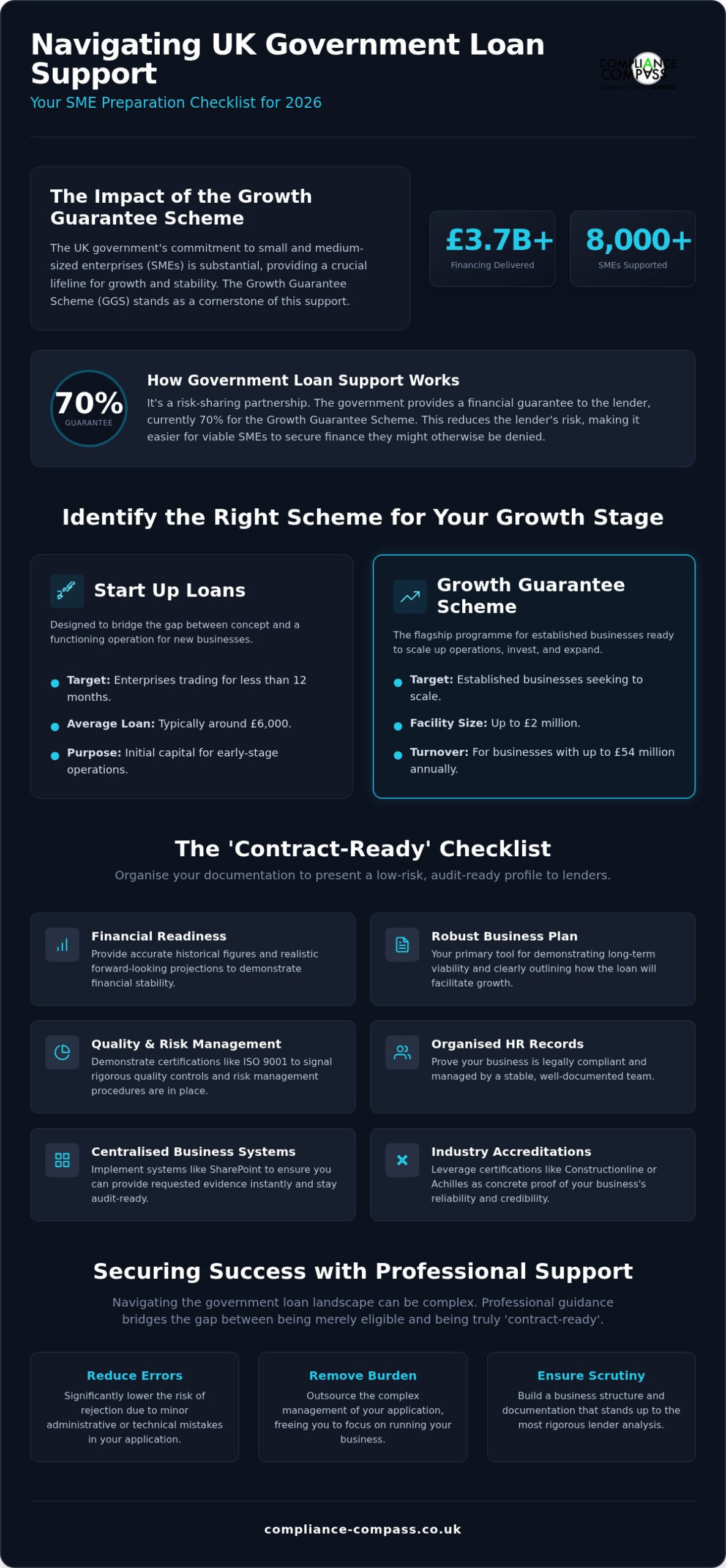
Did you know that the Growth Guarantee Scheme has already delivered over £3.7 billion in financing to 8,000 UK small businesses? Despite this massive injection of capital, many directors still feel overwhelmed by the shifting landscape of government loan support. You might worry that a single missing document or a misunderstanding of eligibility could lead to an immediate rejection. It’s a common frustration, especially when you’re focused on daily operations rather than deciphering administrative fine print.
We’re here to turn that confusion into a clear, manageable path forward. This article provides a comprehensive checklist to help you identify the right funding and ensure your business is ‘contract-ready’ for 2026. We’ll explore the latest Growth Guarantee Scheme updates, list every essential document you need, and explain how to position your financials to win approval with confidence.
Key Takeaways
- Identify which 2026 schemes, such as the Growth Guarantee Scheme, align with your business’s current growth stage and turnover.
- Navigate the latest eligibility thresholds for government loan support to ensure your business qualifies for the 70% state-backed guarantee.
- Organise your financial documentation and business plans using a structured checklist to present a low-risk, audit-ready profile to lenders.
- Streamline your application by understanding how professional support removes administrative barriers and secures your funding more efficiently.
Navigating the Landscape of UK Government Loan Support
In its simplest form, government loan support is a risk-sharing partnership between the state and commercial lenders. The government provides a financial guarantee, currently set at 70% for the Growth Guarantee Scheme (GGS), which reduces the lender’s exposure if a business cannot repay. This mechanism, overseen by the British Business Bank, makes finance accessible to SMEs that might otherwise struggle to secure traditional commercial loans due to limited collateral or shorter trading histories.
It’s vital to distinguish these from grants. While grants are non-repayable funds often tied to specific projects, loans are repayable debt. In the 2026 fiscal climate, the government has shifted focus toward these sustainable, repayable models of government loan support to foster long-term stability across the UK’s small business sector.
Identifying the Right Scheme for Your Growth Stage
Choosing the correct facility depends entirely on where your business stands today. Start-up enterprises trading for less than 12 months often rely on Start Up Loans. These offer smaller injections of capital, with an average loan value of £6,000, designed to bridge the initial gap between a concept and a functioning operation.
For established businesses looking to scale, the Growth Guarantee Scheme is the flagship 2026 programme, succeeding the previous Recovery Loan Scheme. It supports facilities up to £2 million for businesses with an annual turnover of up to £54 million. This funding is particularly effective for firms in the construction or transport sectors that need to invest in new equipment or expand their teams to meet sustainability targets. Identifying the right fit early ensures your application aligns with the lender’s specific risk appetite.
The SME Preparation Checklist: Essential Documentation and Compliance
Lenders participating in government loan support schemes need to see more than just a high turnover; they require evidence of a stable, well-managed organisation. Before you apply, consult the official government finance and support portal to verify which specific documents your chosen lender requires. High-quality preparation turns a complex application into a straightforward approval process. It’s about moving beyond basic eligibility and proving your business is truly ‘contract-ready’.
Compliance standards often act as the missing link in a successful application. For instance, demonstrating ISO 9001 support signals to a bank that you have rigorous quality controls and risk management in place. This reduces their perceived risk significantly; it shows your operations are consistent and scalable. Couple this with organised HR support records to prove your business is legally compliant and managed by a stable team. Finally, a robust SME business plan is your primary tool for demonstrating long-term viability. It should clearly outline how the loan will facilitate growth.
Financial Forecasting and Cashflow Readiness
Reliable data is non-negotiable. Utilising professional bookkeeping support ensures your historical figures are accurate and ready for scrutiny. You must also present a 12-month cashflow forecast that realistically accounts for repayments whilst maintaining operational liquidity. To keep these documents audit-ready, many firms implement centralised business systems like SharePoint. This level of organisation ensures you can provide requested evidence instantly, rather than searching through disparate folders. If you’re feeling overwhelmed by the paperwork, our team can help you prepare your financial records for a smoother application.
Securing Success: How Professional Support Streamlines Your Application
Securing funding is often a high-stakes endeavour. A recent parliamentary report on SME finance highlights that many small firms find the landscape for government loan support increasingly difficult to navigate. This is where professional support bridges the gap. By outsourcing the management of your grant and government loan applications, you remove the administrative burden and significantly reduce the risk of rejection due to minor technical errors.
It’s about shifting your mindset from mere eligibility to being truly ‘contract-ready’. Professional guidance ensures your government loan support application is backed by a business structure that stands up to rigorous scrutiny. Ongoing outsourced support provides a permanent safety net, keeping your operational systems compliant long after the initial funds reach your bank account. This long-term approach prevents the common pitfall of letting standards slip once the immediate pressure of the application fades.
From Application to Accreditation: The Compliance Advantage
Lenders view industry accreditations as concrete proof of reliability. Leveraging certifications like Constructionline support or Achilles demonstrates that your supply chain and safety protocols meet national standards. This external validation acts as a powerful trust signal during credit assessments. Before submitting any paperwork, conducting internal audits helps identify ‘gap areas’ in your financials or processes. This proactive approach allows you to fix issues before a lender discovers them. Being ‘contract-ready’ is the state of having all compliance, HR, and financial systems fully aligned for external scrutiny.
Achieving Growth with Confidence
Securing government loan support in 2026 requires more than just meeting turnover thresholds. It demands a proactive approach to organisational stability and financial transparency. By identifying the scheme that matches your growth stage and ensuring your documentation is audit-ready, you transform a complex administrative hurdle into a strategic advantage. Whether you’re refining your business plan or strengthening your compliance through ISO, FORS, or Constructionline standards, preparation is the foundation of every successful application.
Contact AA Compliance Compass Ltd for expert loan application support
With over 15 years of industry experience, we’re here to lead you to success by simplifying the overwhelming aspects of business management. Let’s work together to make your enterprise contract-ready and secure the funding it deserves.
Frequently Asked Questions
What is the difference between a government grant and a government-backed loan?
The primary difference is that a government grant is non-repayable funding, whereas a government-backed loan must be repaid with interest. In the 2026 fiscal context, government loan support usually refers to schemes where the state guarantees a portion of the debt to the lender. This reduces the lender’s risk but doesn’t remove the borrower’s obligation to settle the full balance.
Can a new start-up apply for government loan support in 2026?
Yes, new enterprises can access funding through the dedicated Start Up Loans scheme. This programme is designed for businesses trading for up to 12 months or those still in the planning phase. It offers an average loan of £6,000 with repayment terms between one and five years, providing essential capital to bridge the initial funding gap before traditional commercial finance becomes available.
Do I need ISO 9001 certification to be eligible for a government business loan?
ISO 9001 certification isn’t a mandatory eligibility requirement for most government loan support schemes, but it significantly strengthens your application. Holding this accreditation proves to lenders that your business operates with documented, high-quality management systems. It acts as a trust signal, suggesting your organisation is a lower-risk investment compared to firms without structured internal controls or audit-ready processes.
What happens if my business cannot repay a government-backed loan?
If your business cannot meet its repayments, you remain 100% liable for the debt. The 70% government guarantee provided through schemes like the Growth Guarantee Scheme is for the lender’s protection, not the borrower’s. Lenders will follow their standard recovery procedures for the full amount, which is why maintaining accurate bookkeeping support for small businesses and realistic cashflow forecasts is vital for long-term stability.
Disclaimer
This article is for general information only and does not constitute legal, financial or professional advice. Requirements may vary, so please seek advice appropriate to your circumstances. AA Compliance Compass Ltd accepts no liability for actions taken based on this content.