Implementing ISO 14001: Why Businesses Struggle and How to Make It Work
Does your environmental management system guide how your business operates, or does it only receive attention when an audit approaches?
Implementing ISO 14001 can feel challenging for SMEs and contractors. Limited time, competing priorities and uncertainty about what is required can leave business owners with documents they rarely use and actions that never quite get completed.
At AA Compliance Compass Ltd, we help businesses turn environmental management into practical processes that fit their operations. Whether you are starting from scratch, preparing for an internal audit or improving an existing system, the aim is to make ISO 14001 useful throughout the year.
What is ISO 14001?
ISO 14001 is the international standard for environmental management systems, often shortened to EMS. It provides a framework for managing environmental responsibilities, setting objectives and improving performance.
The latest edition, ISO 14001:2026, was published in April 2026. Businesses with an existing certified system should discuss their transition arrangements with their certification body.
For a small contractor, environmental management might involve controlling fuel storage, reducing material waste and preparing for spills. For an office-based business, priorities might include electricity consumption, purchasing and the disposal of electronic equipment.
The starting point is understanding your own activities and where they affect the environment.
Five common challenges when implementing ISO 14001
1. Leadership leaves environmental management to one person
An environmental coordinator can organise the system, but they need support from the people making operational and financial decisions.
Problems arise when someone is expected to manage environmental responsibilities alongside their usual workload, without enough time, authority or resources.
A practical solution: Give actions named owners and realistic deadlines. Include environmental performance in management discussions, and make sure those responsible can obtain the resources they need.
For example, replacing damaged spill equipment requires someone to approve the purchase as well as someone to identify the problem.
2. Environmental aspects and impacts feel confusing
The terminology can make a straightforward exercise seem complicated.
An environmental aspect is an activity, product or service that interacts with the environment. An environmental impact is the resulting change.
For example:
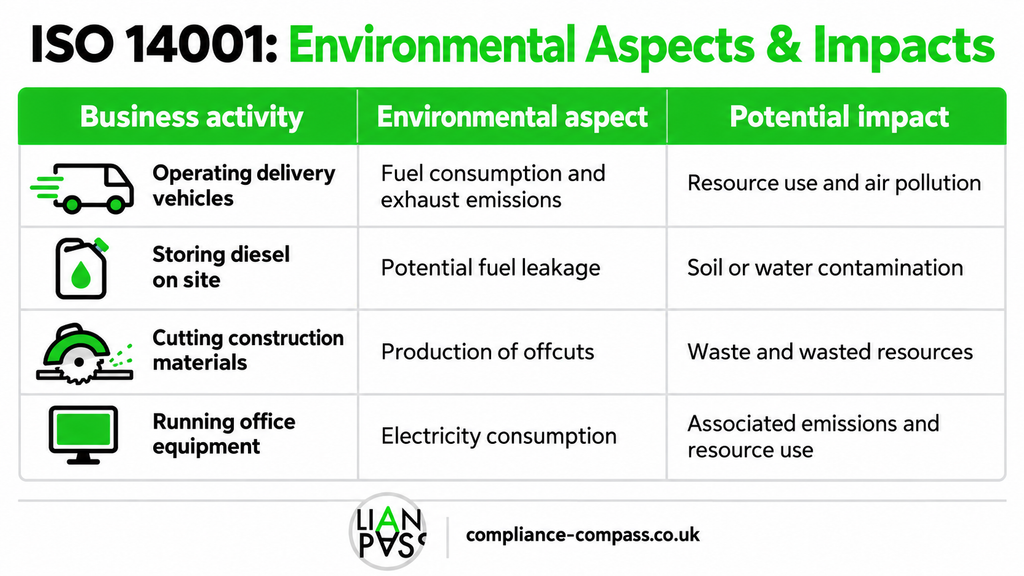
A practical solution: Walk through how your business actually works, from purchasing and deliveries to operations and waste disposal. Consider activities you control and those you can influence, including relevant supplier and contractor arrangements.
Keep the assessment specific to your business. A generic register can overlook the issues that matter most.
3. Compliance information is collected but never checked
A list of legislation is only useful if the business understands which requirements apply and how it meets them.
A common weakness is recording an obligation without identifying who checks it, what evidence is needed or when it should be reviewed.
A practical solution: Connect each applicable obligation to an operational check, a responsible person and supporting evidence. Use reliable sources to review changes relevant to your activities.
An environmental management system should help you organise and evaluate compliance. Holding a certificate does not remove your legal responsibilities.
4. Employees do not understand what they need to do
A procedure stored in a folder will have little effect if the people doing the work have never been shown how it applies.
Instructions such as “follow the environmental policy” are too broad to guide everyday decisions.
A practical solution: Make awareness relevant to each role. Explain where waste belongs, how to report a leak, what to do during a spill and who to contact when something goes wrong.
Short briefings, clear signs and practical demonstrations can make expectations easier to follow. Ask employees where the process causes difficulties; their feedback can reveal why a control is being missed.
5. The system creates unnecessary paperwork
Businesses can make implementation harder by creating overlapping forms, lengthy procedures and records that nobody uses.
This becomes particularly frustrating when quality, environmental and health and safety systems each require the same information.
A practical solution: Use existing business processes wherever they work effectively. Keep documents clear, proportionate and easy to find.
Businesses managing several standards can explore an IMS https://compliance-compass.co.uk/integrated-management-system-support/ to coordinate shared activities such as document control, audits and action tracking.
Do businesses take ISO 14001 seriously enough?
Commitment varies between businesses. Tender requirements, customer expectations and supply-chain conditions can all encourage organisations to seek certification. Certification is voluntary, although individual contracts may require it.
However, external pressure is only part of the picture. Leadership priorities, employee involvement and the usefulness of the system also influence how consistently it is applied.
A helpful question is:
If your next external audit were postponed, would your environmental checks and improvement actions still happen?
Signs of an active system include:
– Employees understanding the controls relevant to their work.
– Managers reviewing results and providing resources.
– Problems being reported and investigated.
– Actions being completed and checked for effectiveness.
– Objectives being reviewed against meaningful information.
The certificate has greater practical value when the processes behind it continue between audits.
How can you make ISO 14001 work for your business?
Start with a manageable plan:
1. Review your current position. Identify what already works and where there are gaps.
2. Prioritise significant issues. Focus effort on the activities and obligations that need the most attention.
3. Agree ownership. Give each action a responsible person and completion date.
4. Choose useful measures. Track information that helps you make decisions, such as material waste or fuel consumption relative to activity.
5. Check effectiveness. Use internal audits and management reviews to identify whether changes are working.
For example, a growing contractor may use more fuel overall while improving fuel efficiency per mile. Looking at both figures gives a clearer picture than relying on total consumption alone.
ISO 14001 support from AA Compliance Compass Ltd
Based near Matlock, Derbyshire, AA Compliance Compass Ltd provides practical support for SMEs and contractors that need help establishing, maintaining or improving their environmental management system.
Support can include:
– ISO 14001 gap analysis.
– Internal environmental management system audits.
– System development and implementation support.
– Reviewing environmental aspects, impacts and supporting records.
– Audit preparation and corrective action support.
– Integration with existing quality and health and safety processes.
Our approach starts with your activities, your team and the processes you already use, helping you develop arrangements that are manageable in everyday business.
Explore our ISO 14001 environmental support services https://compliance-compass.co.uk/iso-14001-environmental-support/.
Frequently asked questions
Can a small business implement ISO 14001?
Yes. ISO 14001 can be used by organisations of different sizes. The system should reflect the business’s activities, environmental impacts and operating circumstances.
Do I need a separate environmental department?
A small business can allocate responsibilities across existing roles. What matters is that people understand their responsibilities and have the competence, time and support to carry them out.
Can AA Compliance Compass Ltd issue my ISO 14001 certificate?
We provide consultancy, implementation and internal audit support. Independent certification is undertaken by a certification body.
Need help getting your ISO 14001 system working?
Whether an audit is approaching or your environmental paperwork needs attention, we can help you identify your next steps.
Book a free 30-minute consultation with Anne https://compliance-compass.co.uk/contact/ to discuss your current system, deadlines and support needs.
Email: anne.ashman@compliance-compass.co.uk
Telephone: 07889 890234
AA Compliance Compass Ltd, Win More Contracts, Reduce Risk, Grow with confidence.