
ISO 45001: More Than a Certificate – How Good Health & Safety Management Can Reduce Accidents, Costs and RIDDOR Incidents AND Make Sure Your team Get Home Safe!
When we talk about ISO 45001, it’s easy to think about policies, risk assessments, audits, procedures and ultimately a certificate on the wall.
But that isn’t what good health and safety management is really about.
At its heart, ISO 45001 is about something much more important:
Making sure people go home safely at the end of the working day.
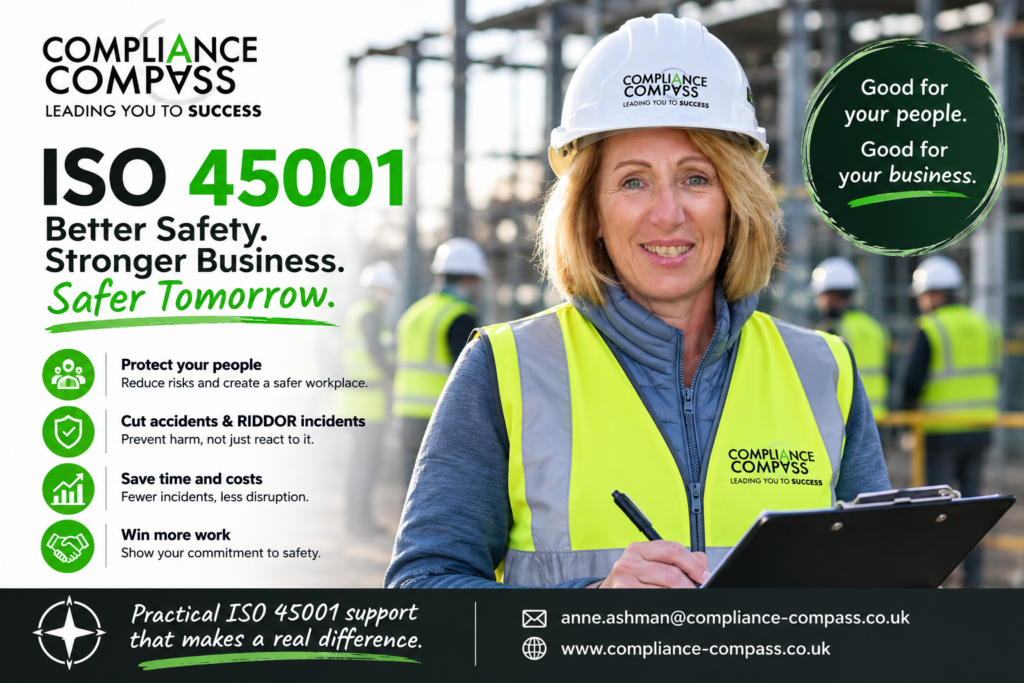
And when it is properly implemented throughout a business, rather than treated as a tick-box exercise, it can also help reduce accidents, disruption, lost time and costs – while strengthening your business and potentially helping you win work.
What is ISO 45001?
ISO 45001:2018 is the international standard for Occupational Health and Safety Management Systems (OHSMS).
It provides businesses with a structured framework for identifying hazards, managing health and safety risks, meeting legal and other requirements, involving workers and continually improving health and safety performance.
Importantly, ISO 45001 isn’t simply about reacting when somebody has an accident.
It’s about asking:
What could go wrong – and what can we do now to prevent it?
That’s a very different approach.
A certificate doesn’t prevent an accident
You can have a fantastic health and safety policy.
You can have risk assessments.
You can have method statements.
You can have training records.
You can even have an ISO 45001 certificate.
But if none of those things influence what actually happens in your workplace, they aren’t controlling the risk.
The HSE makes an important point about management systems: concentrating too heavily on documentation can distract businesses from the human elements of implementation and from actually controlling risks. It also emphasises the importance of attitudes, behaviours and safety culture.
That’s why I believe ISO 45001 needs to get out of the folder and into the business.
What does properly implementing ISO 45001 look like?
It means making health and safety part of normal business operations.
People understand the risks associated with their work.
Risk assessments reflect what actually happens.
Employees are consulted and encouraged to raise concerns.
Near misses are reported rather than ignored.
Incidents are investigated properly.
Corrective actions are completed.
Training is relevant and understood.
Equipment is inspected and maintained.
Suppliers and subcontractors are appropriately controlled.
Management regularly reviews health and safety performance.
Internal audits look at what is actually happening – not simply whether the correct documents exist.
And when something changes within the business, the health and safety implications are considered too.
That’s when your management system starts working for you.
Can ISO 45001 reduce accidents?
No management system can guarantee that an accident will never happen.
But ISO 45001 provides a systematic way of identifying hazards, assessing risks and introducing controls designed to eliminate hazards or reduce the potential for harm. ISO specifically identifies reduced workplace incidents and injuries as one of the benefits of implementing the standard.
Think about the difference between these two approaches.
One business waits for an accident and then investigates what went wrong.
Another identifies the hazard, assesses the risk, puts controls in place, trains its people, checks those controls are working and learns from near misses.
Which business would you rather work for?
That’s the difference between reactive and proactive health and safety management.
And what about RIDDOR?
RIDDOR – the Reporting of Injuries, Diseases and Dangerous Occurrences Regulations – requires certain work-related deaths, injuries, occupational diseases and dangerous occurrences to be reported to the relevant enforcing authority.
Importantly, not every workplace accident is RIDDOR-reportable. Whether an incident must be reported depends on the circumstances and the outcome.
ISO 45001 doesn’t remove your RIDDOR responsibilities.
And having ISO 45001 certification doesn’t mean you won’t ever have a RIDDOR-reportable incident.
What it can do is help you reduce the likelihood of serious incidents occurring in the first place.
If you’re systematically identifying hazards, controlling risks, investigating near misses, involving workers, auditing your operations and taking corrective action, you’re creating opportunities to deal with problems before somebody gets hurt.
And that is surely better than waiting until you’re completing a RIDDOR report to ask:
“How did this happen?”
Near misses matter too
This is an area I think businesses can learn a huge amount from.
Someone trips but doesn’t fall.
Something drops from height but misses somebody.
A vehicle reverses and nearly hits a pedestrian.
A piece of equipment fails but nobody is injured.
It’s easy to say:
“No harm done.”
But there may be an important warning hiding in that near miss.
A strong health and safety culture encourages people to report these events so the business can understand why they happened and whether controls need improving.
The next person might not be so lucky.
ISO 45001 includes incident investigation and continual improvement within its management framework, helping businesses learn rather than simply move on.
Accidents cost businesses money
There’s also a commercial reason for getting this right.
An accident doesn’t only affect the injured person.
It can potentially mean:
Lost working time.
Operational disruption.
Investigation time.
Replacement labour.
Damaged equipment or property.
Increased absence.
Insurance implications.
Customer concerns.
Reputational damage.
And, depending on the circumstances, enforcement action.
ISO identifies potential benefits of ISO 45001 including reduced incident costs, reduced downtime and disruption, lower absenteeism and employee turnover, improved reputation and potentially reduced insurance premiums.
So investing in health and safety isn’t simply a cost to the business.
Preventing accidents can protect your people AND your bottom line.
ISO 45001 can help you win work too
For some businesses, particularly those working within supply chains, construction, transport, manufacturing and other higher-risk sectors, demonstrating strong health and safety management can be commercially important.
Customers want confidence that the businesses they appoint aren’t introducing unnecessary risk.
ISO 45001 provides an internationally recognised framework and can help demonstrate that your organisation takes occupational health and safety seriously.
That can support supplier assessments, tenders and customer confidence.
But there’s an important distinction.
Don’t just get ISO 45001 to win the work. Use ISO 45001 to help you deliver the work safely once you’ve won it.
Internal audits need to look beyond the paperwork
This is where internal auditing becomes particularly valuable.
An ISO 45001 internal audit shouldn’t simply involve sitting at a desk checking whether documents exist.
Sometimes you need to go and look.
Are people actually following the procedure?
Are the controls described in the risk assessment happening?
Is PPE being used correctly?
Do employees understand the risks?
Are subcontractors following your requirements?
Have actions actually been closed?
Have new hazards appeared since the original assessment?
Is the management system reflected in what people do every day?
There can be a huge difference between:
“This is what our procedure says.”
and
“This is what actually happens.”
That’s the gap you want to find before an accident does.
And this is where I can help
You might already take health and safety seriously but not have the time, experience or resources to turn what you’re doing into a structured ISO 45001 management system.
You may need ISO 45001 because a customer or tender requires it.
Or perhaps you already have certification, but your system hasn’t kept pace with your business.
That’s where I can step in.
I can look at how your business actually operates – not how a generic ISO template says it should operate.
I can help you identify the processes and controls you already have, where the gaps are, what needs documenting and, most importantly, whether your management system is actually being implemented.
I can support you with:
- ISO 45001 gap analysis and implementation;
- health and safety management system documentation;
- policies and procedures;
- hazard identification and risk management;
- legal and other requirements;
- objectives and improvement plans;
- worker consultation and participation;
- supplier and subcontractor controls;
- incident and near-miss processes;
- corrective actions;
- internal audits;
- management reviews;
- ongoing ISO maintenance; and
- preparation for certification and surveillance audits.
If you already have ISO 9001 or ISO 14001, I can also help you look at integrating ISO 45001 into your existing management system rather than unnecessarily running separate systems.
It’s not about paperwork – it’s about people
I don’t want to create health and safety documents simply so you can show them to an auditor.
I want the documents to reflect what actually happens in your business.
I want your people to understand them.
I want your risk assessments to control real risks.
I want your audits to identify genuine opportunities for improvement.
I want near misses to become learning opportunities.
I want management to have useful information to make better decisions.
And ultimately:
I want everyone to go home safely at the end of the working day.
If doing that also helps you reduce accidents, reduce downtime, control costs, demonstrate compliance and win work, then your ISO 45001 system is doing exactly what a good management system should do.
Already have ISO 45001 – or thinking about achieving it?
Don’t wait until an external audit or, worse, an accident to find out whether your system is actually working.
If you need an ISO 45001 internal audit, gap analysis, system review, implementation support or help preparing for certification, get in touch.
Anne Ashman | Compliance Compass
Leading You to Success
anne.ashman@compliance-compass.co.uk
compliance-compass.co.uk