
ISO 9001 Requirements UK: Practical SME Guide for 2026
Winning a major government contract or securing a spot on a Tier 1 supply chain often has less to do with your sales pitch and everything to do with a single certificate. You likely already recognise that meeting ISO 9001 certification requirements UK is the key to unlocking these high-value opportunities. However, the thought of deciphering technical jargon like ‘Context of the Organisation’ or ‘Risk-Based Thinking’ whilst managing daily operations can feel completely overwhelming. You want a business that runs like clockwork, not a mountain of pointless paperwork.
This guide provides a clear, jargon-free roadmap to understanding and meeting the latest standards for 2026. We’ll move past the academic definitions to show you how these requirements actually apply to a busy SME. You’ll discover a structured path to becoming contract-ready, including how to handle the new 2026 focus on climate change and digital ethics. By the end of this article, you’ll have a practical action plan to turn a daunting audit process into a tool for genuine internal growth and improved organisation.
Key Takeaways
- Understand how the “Plan-Do-Check-Act” cycle provides a logical framework to improve internal organisation and operational efficiency.
- Navigate the specific ISO 9001 certification requirements UK for 2026, including the latest focus on climate change and ethical business behaviour.
- Learn why a professional gap analysis is the best way to identify exactly what your business needs to achieve UKAS-accredited status.
- Discover how to replace bulky paper manuals with streamlined digital documentation that actually supports your team’s daily work.
- See how a solid quality management system acts as a springboard for other essential industry standards like Constructionline and FORS.
Understanding the ISO 9001:2015 Framework for UK Businesses
ISO 9001 isn’t a rigid set of rules designed to stifle your creativity or slow down your team. Instead, think of it as a Quality Management System (QMS) that ensures your business delivers the same high standard every single time. Even though we’ve entered 2026, the current auditable version remains ISO 9001:2015. A new update is expected later this year, but for now, your focus should be on the 2015 requirements. Mastering these ISO 9001 certification requirements UK creates a foundation of stability that allows your SME to scale without losing control.
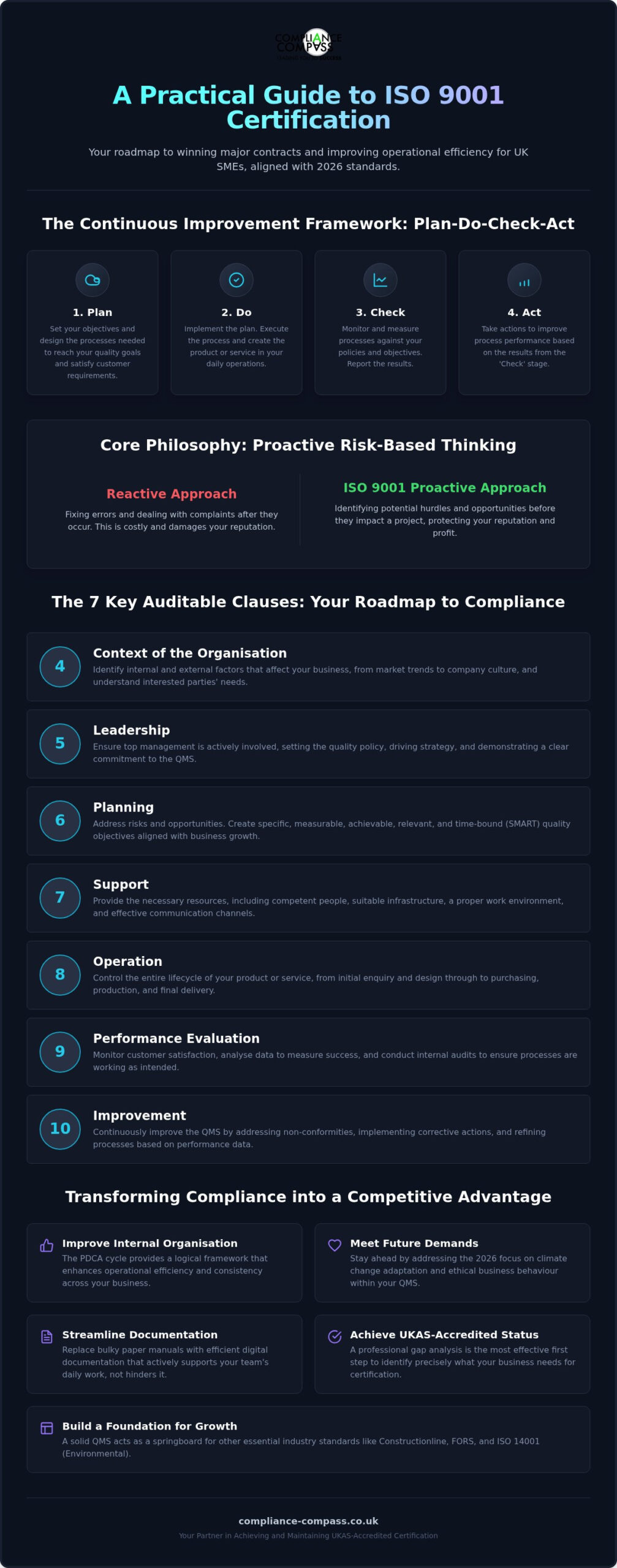
The framework operates on a simple logic known as the Plan-Do-Check-Act (PDCA) cycle. You Plan by setting your objectives and designing the processes needed to reach them. You Do by implementing those plans in your daily operations. You Check by monitoring your performance and identifying where things aren’t quite right. Finally, you Act by making improvements based on your findings. This isn’t a one-off exercise; it’s a continuous loop that keeps your business sharp and competitive.
For UK SMEs, holding this certification is often a commercial necessity. Whether you’re bidding for local council work or aiming to join a Tier 1 supply chain, you’ll find that ISO 9001 is a frequent prerequisite. It belongs to the broader ISO 9000 family of standards, which sets the global benchmark for quality management. Having this badge tells potential partners that you’re a safe pair of hands.
The Core Philosophy: Risk-Based Thinking
Modern quality management moves away from just fixing errors. It focuses on risk-based thinking. This means looking ahead to identify potential hurdles before they cause a project to fail or a client to complain. By addressing these risks early, you protect your hard-earned reputation and your profit margins. SMEs are uniquely well-placed for this. Your teams are usually smaller and more agile, meaning you can spot a shift in the market or an operational flaw and react far faster than a corporate giant could. It’s about being proactive rather than reactive.
The Seven Management Principles
The standard is built on seven core principles that guide how a healthy business should function. These include leadership, engagement of people, and a process-driven approach. Two of the most vital for growth are customer focus and evidence-based decision making. A relentless focus on the customer ensures that every internal process actually adds value to the person paying the bills. Meanwhile, using evidence to make decisions removes the dangerous guesswork often found in small business boardrooms. You start making choices based on facts and data, leading to more predictable and successful outcomes.
The Seven Key Clauses of ISO 9001 Requirements
While the standard contains ten clauses in total, the first three are essentially introductory. The real work for your business begins at Clause 4. These are the auditable ISO 9001 certification requirements UK assessors will look for during your visit. Understanding these sections helps you build a system that supports your staff rather than just ticking boxes for a certificate.
Clause 4: Context of the Organisation asks you to look at the big picture. You’ll identify the internal and external factors that affect your business, from market trends to your own company culture. Clause 5: Leadership ensures that quality isn’t just a task for the “shop floor”. Auditors want to see that the “top floor” is actively involved in setting the quality policy and driving the strategy forward. Clause 6: Planning is where you set meaningful quality objectives. Instead of vague goals, you’ll create targets that are measurable and aligned with your business growth. Finally, Clause 7: Support ensures your team has the right resources, training, and tools to do their jobs well. For those seeking an in-depth guide to ISO 9001:2015, these clauses form the backbone of a resilient business.
Operational Control and Performance (Clauses 8-9)
Clause 8 is the engine room of your quality management system. It covers the entire lifecycle of your product or service, from the initial sales enquiry through to design, purchasing, and final delivery. It’s about ensuring every step is controlled and consistent. Clause 9 then asks you to step back and evaluate how you’re doing. You’ll need to monitor customer satisfaction and use data to measure your success. This stage includes the internal audit. An internal audit is simply a friendly health check for your processes to ensure they’re working as intended. If you’re feeling unsure about this step, our team can provide a professional Internal Audits & Gap Analysis to give you peace of mind.
Continual Improvement (Clause 10)
No business is perfect, and the standard doesn’t expect you to be. Clause 10 focuses on what you do when things go wrong. When you identify a non-conformity, the goal is to handle it without panic. You’ll investigate the root cause and take corrective action to prevent the same mistake from happening again. This commitment to getting better every day is a powerful tool for your SME. It turns every challenge into a lesson, providing a great narrative for your annual business review and proving to your clients that you’re dedicated to long term excellence.
Essential Documentation and Evidence Requirements
Many SMEs dread the documentation phase, picturing rows of lever-arch files gathering dust on a shelf. This is a common misconception. In the modern digital age, the standard uses the term “documented information” to cover everything from PDFs to cloud-based logs. You don’t need a massive, academic manual to meet ISO 9001 certification requirements UK. In fact, the 2015 update specifically moved away from prescriptive paperwork to give businesses more flexibility in how they prove their processes work.
The list of truly mandatory documents is surprisingly short. You must define your Scope (the boundaries of your business), a Quality Policy (your high-level commitment to standards), and your Quality Objectives (the specific, measurable goals you’re chasing). Beyond these, the focus shifts from “writing” to “doing”. An auditor would much rather see a messy logbook that proves you’re checking your work than a pristine manual that nobody actually follows. Evidence of action is always more valuable than a perfect essay on intent.
Developing a Lean Quality Manual
Your quality manual should be a living document, not a museum piece. To make it useful, keep it lean. Use flowcharts and diagrams to map out your processes instead of using dense paragraphs of text. Most people process visual information faster; it’s much easier for a new starter to follow a simple map than a ten-page essay. By linking your manual directly to your daily operations, it becomes a helpful tool for training and consistency rather than a regulatory burden that staff try to avoid.
Records and Evidence for the Auditor
When the auditor arrives, they’ll look for evidence that your system is functioning. This evidence can take many forms, including saved emails, digital logs, minutes from management meetings, or training records. One of the most common pitfalls for SMEs is version control. If half your team is using an old version of a form whilst the others use the new one, it suggests your system isn’t under control. Organising these records can be the most stressful part of the process. At Anne Ashman’s Compliance Compass, we provide hands-on Business Systems Support to help you categorise and store your evidence logically. This ensures that when an auditor asks for proof of a process, you can find it in seconds, demonstrating a high level of control and competence.
Navigating the UKAS-Accredited Certification Process
Securing your certificate isn’t an overnight event. It’s a methodical journey that transforms how your business operates. To meet ISO 9001 certification requirements UK, you’ll typically follow a five-step path. It begins with a Gap Analysis, where you compare your current ways of working against the standard. Once you know what’s missing, you move to System Implementation, building the practical processes we’ve already discussed. Before the official assessors arrive, you’ll conduct an Internal Audit as a final mock exam. The daily rate for a UKAS-accredited auditor in 2026 typically ranges between £850 and £1,500. Because of this cost, you want to be certain you’re ready. The Formal Assessment follows, split into Stage 1 (a review of your documentation) and Stage 2 (an onsite visit). Finally, you’ll enter Ongoing Surveillance to keep your badge for the long term. Understanding the full ISO certification journey for SMEs before you begin helps you allocate time and resources far more effectively at each stage.
Why UKAS Accreditation is Non-Negotiable
The United Kingdom Accreditation Service (UKAS) is the only national body recognised by the government to assess certification bodies. You might see “non-accredited” options online that promise a quick badge for a few hundred pounds. Avoid these. Major contractors and public sector tenders often specifically require a UKAS-accredited certificate. Without that “tick and crown” logo, your investment could be rejected at the first stage of a bid. We help you select the right UKAS-accredited body to ensure your certificate carries the weight you need to win new business.
The Role of an ISO Consultant vs. an Auditor
It’s vital to understand that the person who helps you build your system cannot be the one who audits it for certification. This separation of duties ensures the process remains impartial. An auditor is there to judge the system’s compliance. A consultant, however, acts as your coach and advocate. We act as a “translator”, helping you understand what the auditor is asking for and ensuring your team feels confident during the visit. By outsourcing the heavy lifting to us, you can focus on running your business whilst we handle the technical complexities. If you’re ready to start your journey, our ISO 9001 Support services provide the expert guidance you need to pass with confidence.
Overcoming Common Barriers: Making ISO 9001 Work for You
Many SME owners look at the technical requirements and think they’re far too small for this level of detail. It’s a common fear, but ISO 9001 is designed to be completely scalable. Whether you’re a team of five or five hundred, the core principles of quality and consistency remain the same. Meeting ISO 9001 certification requirements UK isn’t about adding layers of bureaucracy. It’s about formalising the good work you’re already doing. When you position certification as a milestone for growth rather than a hurdle to it, your team starts to see the value in streamlined processes.
Think of this standard as a foundation for other industry accolades. If your business operates in construction or transport, you’ll likely need Constructionline or FORS accreditation. Because ISO 9001 establishes a robust quality management system, you’ve already completed the hardest part of those applications. It’s about building a business that is inherently contract-ready from the ground up. With a 97% approval rate for the upcoming 2026 standard update amongst member bodies, it’s clear that this framework remains the global language of business excellence. This shift in mindset helps motivate staff who might otherwise see compliance as a box-ticking exercise. When they see how it reduces rework and clarifies their roles, they become active participants in the company’s success. Pairing your quality management system with a well-structured SME business plan for sustainable growth ensures your compliance efforts are fully aligned with your wider commercial strategy. Working with a dedicated ISO 9001 consultant for small business can make this cultural shift far smoother, ensuring your team gains confidence in the system from day one.
Integrating Multiple Standards
Most modern ISO standards, including ISO 14001 (Environmental) and ISO 45001 (Health & Safety), now follow a “Harmonised Structure”. This means they share the same clause numbers and core definitions. By creating an Integrated Management System (IMS), you can manage all three standards through a single set of documents. This approach significantly reduces the duplication of effort and ensures your business systems are aligned. You save time, reduce audit fees, and create a clearer path for your staff to follow.
How Compliance Compass Simplifies the Journey
We understand that running a small business is a constant balancing act. Our role is to act as your pragmatic mentor, stripping away the academic fluff to focus on what actually moves the needle for your operations. We don’t just help you tick boxes. We help you build a more efficient, profitable business that can compete with industry giants. If you’re ready to remove the barriers to your growth, book a gap analysis with Compliance Compass today to see where you stand.
Take the Next Step Towards Operational Excellence
Achieving certification doesn’t have to be a daunting or academic process. By focusing on practical implementation and lean documentation, you can turn the ISO 9001 certification requirements UK into a powerful engine for your business growth. A well-structured system doesn’t just help you win major contracts; it creates a more organised, stress-free environment for your entire team. Whether you’re aiming for Constructionline or simply want to improve your internal consistency, the right foundation makes all the difference.
At Compliance Compass, we provide SME-focused practical support across the UK. We act as a safe pair of hands, handling the heavy lifting of gap analysis and internal audits to ensure your firm is truly contract-ready. We’ll help you navigate the technical jargon and build a system that works for your unique operations, not the other way around.
Let Compliance Compass guide you to ISO 9001 success and start your journey with a partner who understands the daily pressures of running an SME. You’ve built a great business; now it’s time to show the world you’re ready for the next level.
Frequently Asked Questions
Is ISO 9001 certification mandatory for UK businesses?
No, it isn’t a legal requirement for businesses in the UK. However, it’s often a commercial necessity for winning public sector contracts or joining Tier 1 supply chains. Many organisations won’t even consider your bid without proof that you meet ISO 9001 certification requirements UK. It acts as a universal badge of trust that proves your internal systems are robust, reliable, and capable of delivering consistent quality.
How much does ISO 9001 certification cost for an SME?
Costs vary based on your company size and the complexity of your processes. You should budget for two separate elements: the implementation support to build your system and the formal fees charged by a UKAS-accredited certification body. For a small firm, the initial certification fees typically start in the low thousands. Investing in professional support early often reduces these costs by ensuring you pass your audit the first time without expensive re-visits.
How long does it typically take to get certified in the UK?
Most UK SMEs achieve certification within three to six months. This timeline depends on the results of your initial gap analysis and how much time your team can dedicate to implementing new processes. If your existing systems are already strong, the journey can be faster. We focus on a methodical approach that ensures your system is fully embedded and functional before the final assessment takes place.
What is the difference between ISO 9001 and ISO 9001:2015?
ISO 9001 is the name of the standard, whilst ‘2015’ refers to the specific version currently in use. A new update, ISO 9001:2026, is expected to be published in September 2026. Once released, businesses will have a three-year transition period to migrate to the new version. For now, all UKAS audits are conducted against the 2015 framework, which remains the core of ISO 9001 certification requirements UK.
Can a small business with only 5 employees get ISO 9001?
Yes, businesses of any size can achieve certification. The standard is designed to be flexible and scalable, meaning it’s just as applicable to a micro-business as it is to a multinational corporation. For a small team, the requirements are often simpler to implement because communication is more direct. We specialise in helping smaller firms build lean systems that don’t overwhelm their limited resources or staff time.
What happens if we fail our ISO 9001 audit?
You don’t fail in the traditional sense; instead, the auditor identifies non-conformities. These are areas where your system doesn’t quite meet the standard. You’ll be given a specific timeframe to take corrective action and provide evidence of the fix. Once these points are closed off, the auditor will recommend you for certification. It’s a constructive process designed to help you improve your business rather than a simple pass or fail test.
Do we need a full-time Quality Manager to maintain the standard?
You don’t need a full-time staff member dedicated solely to quality management. In many SMEs, the responsibility is shared amongst existing directors or office managers. Alternatively, many firms choose to outsource the heavy lifting to a partner like Compliance Compass. This ensures your system stays compliant and up to date without the overhead of a permanent salary, allowing you to focus on your core daily operations.
How often do we need to be re-audited to keep our certification?
To maintain your certificate, you’ll undergo annual surveillance audits by your certification body. These are smaller checks to ensure you’re still following your processes and making improvements. Every three years, a more thorough recertification audit takes place to renew your certificate for another cycle. Staying on top of your internal audits throughout the year makes these external visits a straightforward and stress-free experience for your team.
Disclaimer
This article is for general information only and does not constitute legal, financial or professional advice. Requirements may vary, so please seek advice appropriate to your circumstances. AA Compliance Compass Ltd accepts no liability for actions taken based on this content.