
Tender Compliance: A Practical Guide for UK SMEs 2026
Last Tuesday, a business owner named Sarah discovered that a single expired certificate had disqualified her firm from a major local authority framework they were perfectly placed to win. It’s a frustrating reality for many UK SMEs, where the fear of a minor administrative error in your tender compliance requirements can overshadow the quality of the actual bid. You likely feel the same pressure when faced with complex portals and ISO standards, wondering if your documentation will stand up to scrutiny.
This guide removes that stress by providing a clear roadmap for mastering compliance in 2026. We’ll explore essential certifications, the latest updates from the Procurement Act 2023, and how to build a practical document management system. By the end, you’ll have the confidence to bid for larger contracts, knowing your business is permanently audit-ready and professional.
Key Takeaways
- Recognise compliance as the mandatory gateway where a single missing certificate can lead to automatic disqualification regardless of your proposal’s quality.
- Master the core tender compliance requirements by centralising your legal, financial, and insurance records into a system that remains audit-ready throughout the year.
- Utilise ISO standards and certifications to build immediate trust with buyers, demonstrating a professional commitment to quality and safety management.
- Move away from stressful “panic bidding” by implementing internal audits that identify potential gaps in your documentation before they impact your success rate.
Understanding Tender Compliance Requirements: Why SMEs Often Fall at the First Hurdle
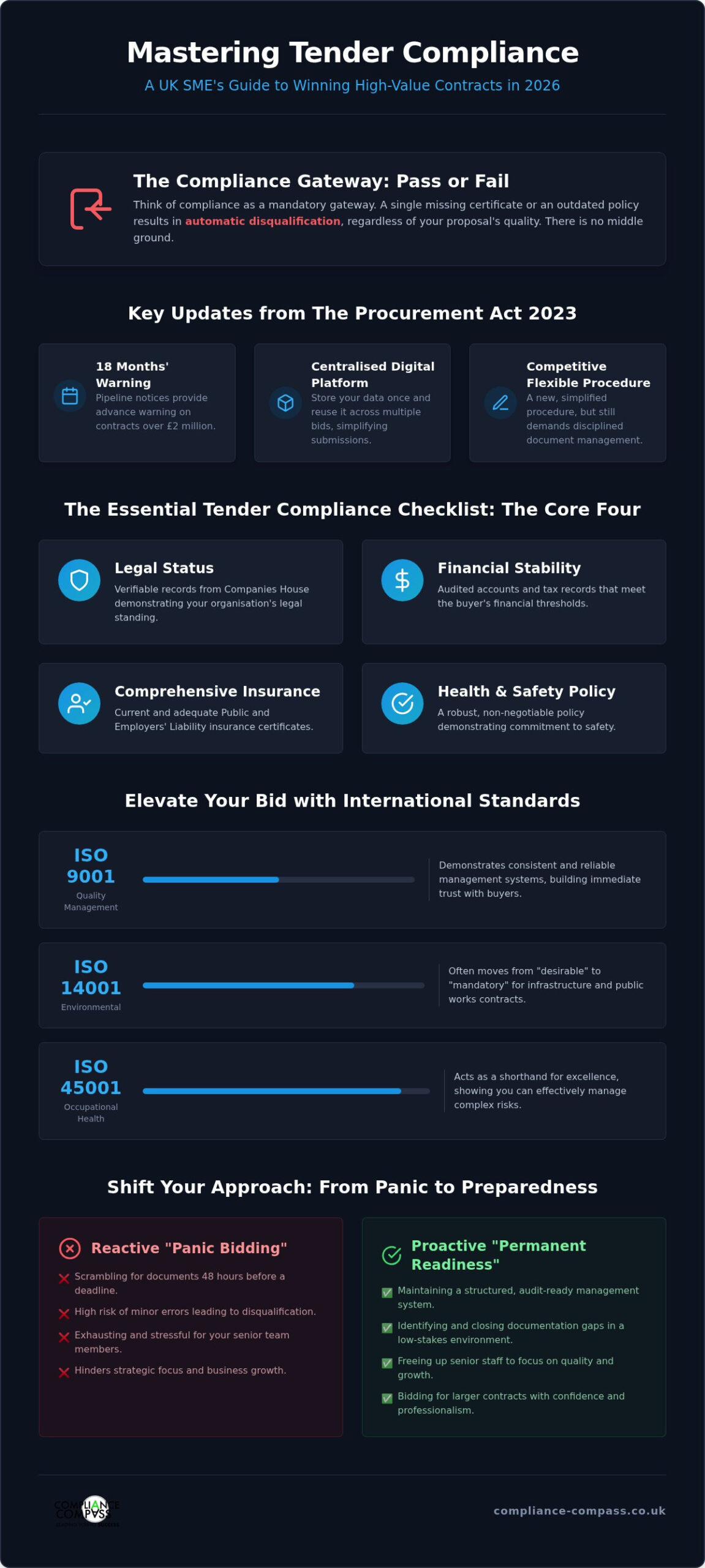
Think of tender compliance as the mandatory gateway you must pass before a buyer even reads your proposal. It doesn’t matter how innovative your solution is or how competitive your pricing looks if you fail to meet the basic tender compliance requirements. In the world of public procurement, checks are strictly pass or fail. A single missing insurance certificate or an outdated health and safety policy results in automatic disqualification. There’s no middle ground; you’re either in the race or you’re out.
Buyers use the Selection Questionnaire (SQ), or the newer Procurement Selection Questionnaire (PSQ), to filter out high-risk suppliers. This assesses your organisational capability and how you meet tender compliance requirements. They’re looking for stability, legal standing, and evidence that you’ve handled similar contracts before. If your audited accounts or tax records don’t align with their thresholds, your journey ends at the first gate.
The Impact of the Procurement Act 2023 on UK Tendering
The Procurement Act 2023, which came into force on 24 February 2025, aims to level the playing field for smaller firms. Pipeline notices now give you 18 months’ warning on contracts over £2 million. Centralised digital platforms allow you to store your data once and use it across multiple bids. This shift towards transparency makes the process more visible, yet the burden of proof still rests entirely on your shoulders. You must demonstrate you meet high standards every time.
Whilst the Act simplifies procedures through the new “competitive flexible procedure”, it requires a disciplined approach to document management. Using a structured business system ensures your evidence is always current. It’s about moving from reactive document gathering to a state of permanent readiness.
The Essential Tender Compliance Checklist: Mandatory Documents and Certifications
To secure your spot on any shortlist, you must first satisfy the “Core Four” pillars of documentation. These include your legal status via Companies House records, financial stability through audited accounts, and proof of comprehensive Public and Employers Liability insurance. Finally, a robust Health and Safety policy is non-negotiable. Meeting these basic tender compliance requirements provides the foundation for more advanced certifications and builds immediate trust with potential buyers.
Buyers increasingly look for international benchmarks to verify your operational quality. Accessing ISO 9001 support helps you prove that your management systems are consistent and reliable. For high-value infrastructure or public works, you’ll likely find that ISO 14001 (environmental) and ISO 45001 (occupational health) have moved from “desirable” to mandatory tender compliance requirements. These standards act as a shorthand for excellence, showing you can manage complex risks effectively.
Industry-Specific Portals: Constructionline and Achilles Accreditation
Major organisations in the utilities and construction sectors use specialised portals to pre-qualify their supply chains. Gaining Achilles support or Constructionline support is often a prerequisite just to view tender documents. Higher tiers, such as the Constructionline Platinum level, unlock the most prestigious contracts by demonstrating a superior level of risk management and corporate social responsibility.
Managing these portals requires constant attention to ensure no certificate expires at a critical moment. Many SMEs find that having a professional partner to oversee these platforms saves significant time and prevents avoidable disqualifications. If you’re unsure where your current documentation stands, you might consider an internal audit to identify any hidden gaps before your next big bid.
How to Organise Your Business for Permanent Tender Readiness
Many SMEs fall into the trap of “panic bidding”, where they scramble to locate insurance certificates and policy documents 48 hours before a deadline. This reactive approach is both risky and exhausting for your team. Instead, you should aim for a permanent state of audit-readiness. By maintaining a structured management system, you ensure that all tender compliance requirements are met long before a contract notice even appears on your radar. Embedding business process improvement for SMEs into your operations is a proven way to eliminate the admin waste and manual document handling that so often leads to last-minute compliance failures.
A proactive Internal Audit is your most effective tool for maintaining this standard. It allows you to act as your own toughest critic, identifying missing certifications or outdated policies in a low-stakes environment. Outsourcing these compliance functions reduces the administrative burden on your senior staff. It frees you to focus on strategic growth and service delivery whilst experts ensure your documentation remains flawless and current.
Leveraging SharePoint and Outsourced Support for Document Control
A centralised Business System built on Microsoft SharePoint provides a secure, single source of truth for your compliance evidence. Integrating tools like Microsoft Copilot further enhances this by allowing you to retrieve specific data for complex tender questions in seconds. This eliminates hours of manual searching across various folders and portals, giving you more time to refine the quality of your bid.
To ensure your current setup meets the evolving tender compliance requirements for 2026, you can contact AA Compliance Compass for a comprehensive gap analysis. We act as a hands-on partner to help you move from administrative chaos to a controlled, winning process that scales with your business ambitions.
Securing Your Future Through Permanent Audit Readiness
Mastering your tender compliance requirements isn’t just about winning a single contract; it’s about building a stable foundation for long-term growth. By moving away from reactive document gathering and embracing structured business systems, you ensure your firm is always prepared for the next big opportunity. Whether you’re aiming for Constructionline Platinum or navigating the new Procurement Act 2023, success depends on meticulous organisation and professional standards.
With over 15 years of industry experience, we specialise in ISO 9001, 14001, and 45001 compliance. We’re here to provide the practical, hands-on support you need to turn complex regulations into a clear competitive advantage.
Contact AA Compliance Compass for a Gap Analysis and Tender Readiness Support
Take the first step today to remove the stress of compliance and start bidding with absolute confidence.
Frequently Asked Questions
What happens if I submit a non-compliant tender?
Submitting a non-compliant bid typically leads to immediate disqualification. Since compliance checks act as a pass or fail gateway, any missing document or minor administrative error stops your proposal from moving to the quality evaluation stage. This makes understanding the specific tender compliance requirements for each individual contract the most vital part of your preparation. Don’t let a brilliant bid fail on a technicality.
Is ISO 9001 mandatory for all UK government tenders?
ISO 9001 isn’t mandatory for every contract, yet it’s often a prerequisite for large-scale public sector frameworks. For smaller contracts, it might be listed as “desirable” rather than “essential”. However, having this certification simplifies the bidding process as it provides pre-verified proof of your quality management systems. This often allows you to bypass several detailed questions regarding your internal operational standards.
How far back do financial records need to go for tender compliance?
You’ll generally need to provide financial records, such as audited accounts or tax returns, covering the last two to three years. Buyers use these documents to verify your turnover and ensure your business is stable enough to deliver the contract. If your firm hasn’t been trading that long, you should check if the buyer accepts alternative evidence like bank references or a parent company guarantee.
Can an SME bid for a contract if they are currently working towards an accreditation?
This depends entirely on the buyer’s specific rules. Some tenders allow you to submit a bid if you can prove you’re in the final stages of accreditation with a confirmed audit date. Others require you to hold the certificate at the point of submission. Always review the “conditions of participation” early to see if your current progress meets the mandatory tender compliance requirements.
Disclaimer
This article is for general information only and does not constitute legal, financial or professional advice. Requirements may vary, so please seek advice appropriate to your circumstances. AA Compliance Compass Ltd accepts no liability for actions taken based on this content.