
How to Organise Professional Bookkeeping for Startups: A Practical 2026 Guide
What if the hours you currently spend wrestling with receipts could be used to win your next major client instead? Many founders find that the initial excitement of launching a company is quickly dampened by the complexities of professional bookkeeping for startups. It’s exhausting to feel buried under paperwork whilst worrying about HMRC deadlines or whether your records are truly compliant. You likely started your business to follow a passion, not to become an amateur clerk. It’s frustrating to feel like your growth is being held back by administrative bottlenecks.
This guide provides a clear roadmap to establishing a robust financial foundation that scales with your ambition. We’ll show you how to move beyond basic spreadsheets to create a system that ensures UK compliance and leaves you “contract-ready” for new opportunities. You’ll learn how to separate bookkeeping from accounting, organise your expenses, and reclaim the time needed to focus on your core business goals. Let’s transform your financial management from a source of anxiety into a practical tool for growth.
Key Takeaways
- Understand the critical distinction between daily record-keeping and high-level accounting to build a scalable financial foundation for your business.
- Learn how professional bookkeeping for startups ensures you remain compliant with UK standards whilst keeping personal and business finances strictly separate.
- Discover the essential steps to establishing a digital, MTD-compliant system that simplifies audit trails and reduces administrative errors.
- Evaluate the strategic benefits of outsourcing your financial records to a safe pair of hands, freeing you to focus on core business growth and sales.
What is Professional Bookkeeping and Why Does Your Startup Need It?
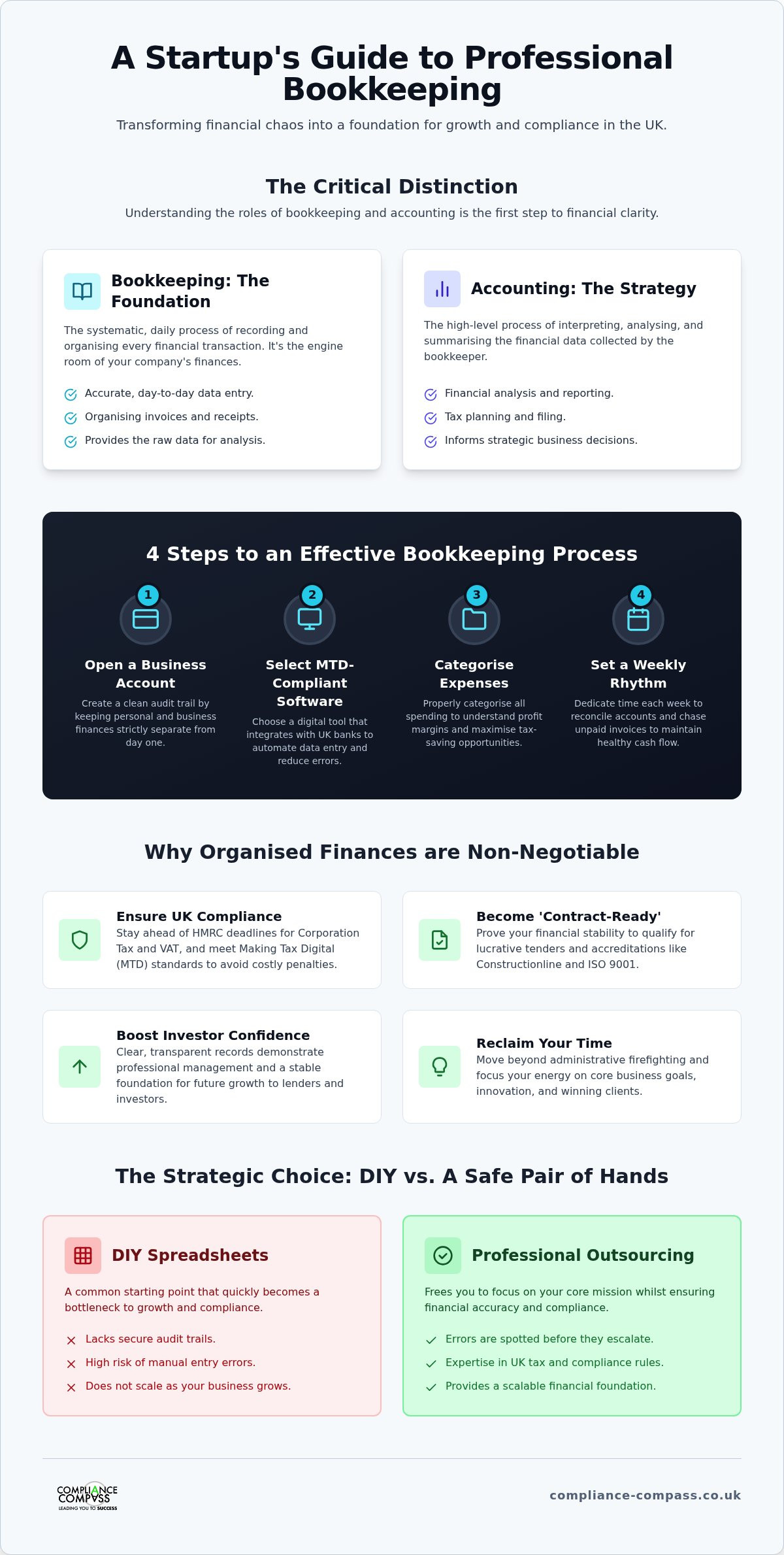
Professional bookkeeping for startups is the systematic process of recording and organising every single financial transaction your business makes. It’s the daily engine room of your finances. Whilst many people confuse it with accounting, there’s a vital distinction. Bookkeeping focuses on the accurate, day-to-day entry of data; accounting uses that data for high-level analysis and tax filing. Without the foundation of clean books, an accountant’s job becomes significantly more difficult and expensive.
Startups often fall victim to ‘shoebox syndrome’, where receipts and invoices are stuffed into physical or digital folders with no clear structure. This disorder creates a massive barrier when you want to scale. Organised records are the first step to becoming ‘contract-ready’. If you’re eyeing larger UK tenders or frameworks, such as Constructionline, having professional financial records is a non-negotiable requirement to prove your stability.
The Difference Between DIY and Professional Oversight
Many founders begin with simple spreadsheets. This works for a few transactions, but as your business grows, spreadsheets often fail. They lack the audit trails and integration needed for modern compliance. Professional bookkeeping for startups involves a level of precision that DIY methods can’t match. Fully qualified bookkeepers act as a safe pair of hands, spotting potential errors in your records before they escalate into costly HMRC penalties or missed VAT deadlines.
How Organised Finances Support Your Business Mission
Clean books do more than just satisfy the taxman. They provide the clarity needed to lead with confidence. When your finances are organised, you stop wasting time on administrative firefighting and start focusing on your core passion. Investors and lenders also prioritise startups with professional financial records. Clear, transparent data proves that you’re a serious operator who understands the value of stability and progress.
Essential Financial Records and UK Compliance Standards
Establishing professional bookkeeping for startups requires a disciplined approach to daily record-keeping. You must retain every sales invoice, purchase receipt, and bank statement. Mixing personal and business finances is a common pitfall that complicates audits and clouds your financial health. From day one, use a dedicated business account to ensure every penny is accounted for. This clarity is essential for managing PAYE and workplace pension contributions as you hire your first team members.
Navigating HMRC Requirements and Deadlines
HMRC expects precise records for Corporation Tax, VAT, and National Insurance when managing professional bookkeeping for startups. Under the 2026 Making Tax Digital (MTD) rules, digital record-keeping is a mandatory standard for most businesses. Non-compliance often leads to heavy fines or the intrusive stress of a full audit. Staying organised protects your cash flow and your reputation. If you’re feeling overwhelmed, starting a conversation with a specialist can simplify these complex duties.
Preparing for Future Accreditations
High-quality records do more than satisfy the taxman. They form the backbone of ISO 9001 quality management standards, which prioritise process consistency and documentation. If your goal is to secure Constructionline or FORS accreditation, financial transparency is a prerequisite. These bodies look for evidence of stability and professional management. Establishing these habits early ensures you’re ready to apply for lucrative frameworks without a last-minute scramble for documentation. Clear books prove you’re a safe pair of hands for large-scale contracts.
Steps to Establishing an Effective Bookkeeping Process
Establishing a structured workflow is the only way to move from administrative chaos to operational clarity. Professional bookkeeping for startups begins with four non-negotiable steps that provide the foundation for your future growth:
- Open a dedicated business bank account: This ensures a clean audit trail and keeps personal spending separate from your commercial operations.
- Select MTD-compliant software: Choose a digital tool that integrates directly with UK banking to automate data flow and reduce manual entry errors.
- Categorise expenses correctly: Doing this from the outset helps you maximise tax-saving opportunities and understand your true profit margins.
- Set a weekly rhythm: Dedicate time every Friday for reconciling accounts and chasing unpaid invoices to maintain healthy cash flow.
Following this sequence creates a predictable environment where your financial data is always current and reliable.
Choosing the Right Tools and Systems
Cloud-based platforms offer real-time visibility, yet software alone isn’t a magic solution. Whilst digital tools automate data entry, they can’t replace the strategic oversight of a qualified bookkeeper. A common mistake amongst new founders is assuming software ‘does the books’ for them. In reality, professional bookkeeping for startups requires a logical system to ensure data integrity. A qualified professional helps configure these tools to match your specific business model and reporting needs.
Weekly vs Monthly Bookkeeping Tasks
Avoid the month-end scramble by committing to a Friday routine. Use this time to upload receipts, approve pending invoices, and reconcile bank transactions. Regular reconciliation is the only way to monitor your actual cash runway with precision. It highlights discrepancies early, such as duplicate payments or unrecognised bank fees, before they impact your bottom line. This weekly habit transforms financial management from a looming deadline into a manageable task that keeps you in total control.
Speak to our experts about setting up your systems
The Strategic Case for Outsourcing Your Bookkeeping
Outsourcing your financial records is a strategic move that places a ‘safe pair of hands’ in charge of your data. For many founders, the cost-benefit analysis is immediate and clear. Every hour you spend categorising receipts is an hour not spent on sales, networking, or product development. By choosing professional bookkeeping for startups, you mitigate operational risks and ensure that your audit trail remains flawless for future inspections. AA Compliance Compass acts as a natural extension of your team, providing the ‘expert-next-door’ guidance needed to navigate complex financial questions. This transition turns a source of constant anxiety into a reliable asset that drives your commercial progress.
Identifying Money-Saving Opportunities
A fully qualified bookkeeper does more than record data; they provide professional advice on saving money. They identify tax-deductible expenses that founders often overlook, ensuring you aren’t paying more than necessary. This oversight improves business efficiency and reduces waste by highlighting unnecessary subscriptions or duplicate costs that often go unnoticed in the rush of daily operations. It’s a proactive approach that adds genuine value to your bottom line whilst maintaining strict UK compliance standards.
Ready to Focus on Growth?
Transitioning from DIY chaos to a managed service is a straightforward process that doesn’t disrupt your daily operations. We help you move from messy spreadsheets to a structured, professional bookkeeping for startups model that supports long-term stability. This change allows you to lead with a clear head, knowing your financial health is monitored by experts. It’s time to step away from the spreadsheets and return to the core passion that started your journey.
Contact AA Compliance Compass for professional bookkeeping support
Building a Scalable Financial Foundation
Organising your financial records is more than a compliance duty; it’s a strategic investment in your company’s future. By establishing a clean audit trail and adopting digital systems, you ensure your business remains resilient against regulatory changes. Professional bookkeeping for startups removes the administrative burden that often distracts founders from their core mission. You gain the clarity needed to make informed decisions and the transparency required to secure larger contracts or investment.
Our team of fully qualified bookkeepers acts as a collaborative partner, offering practical advice on saving money whilst ensuring you meet all UK standards. We specialise in SME compliance, providing the stability you need to scale with confidence.
Secure your startup’s financial future with professional bookkeeping from AA Compliance Compass
Transitioning to a managed service simplifies your operations and protects your most valuable asset: your time. Lead your business with the certainty that your finances are in a safe pair of hands.
Frequently Asked Questions
Is professional bookkeeping different from hiring an accountant for my startup?
Yes, bookkeeping is about the daily recording of transactions, whilst accounting focuses on high-level analysis and tax strategy. Bookkeepers ensure your data is accurate and compliant every week. Accountants then use these records to file year-end returns and provide strategic tax advice. Professional bookkeeping for startups creates the foundation that allows an accountant to work efficiently without charging you for basic data cleanup.
Can a startup manage its own bookkeeping using software like Xero or QuickBooks?
You can technically manage your own records, but software is only a tool, not a complete solution. Without professional oversight, it’s easy to miscategorise expenses or miss VAT reconciliation deadlines. Many founders find that ‘DIY’ bookkeeping leads to messy data that requires expensive correction later. A qualified professional ensures your system is set up correctly from the start, preventing compliance gaps and ensuring your records are audit-ready.
How many hours a week should a startup founder spend on bookkeeping?
A founder typically spends three to five hours a week on financial administration if they’re doing it manually. This includes reconciling bank statements, uploading receipts, and chasing unpaid invoices. Whilst this may seem manageable initially, these hours are often better spent on business development or sales. Outsourcing professional bookkeeping for startups reclaims this time, allowing you to focus on your core passion whilst experts handle the data.
What are the most common bookkeeping mistakes that lead to HMRC fines?
Common errors include missing VAT registration thresholds, failing to keep business and personal finances separate, and losing physical receipts. Inaccurate payroll records or late PAYE submissions also trigger automatic penalties. HMRC requires precise digital records under Making Tax Digital (MTD) rules. A systematic approach prevents these oversights, ensuring you stay compliant with UK regulations and avoid the stress of an unexpected and intrusive financial audit.
When is the right time for a startup to outsource their bookkeeping functions?
The ideal time to outsource is before your transaction volume becomes overwhelming or when you prepare for accreditation like ISO 9001. If you find yourself spending weekends on spreadsheets or worrying about tax deadlines, your business has outgrown a DIY approach. Partnering with a specialist early ensures your financial systems are scalable. This proactive step provides the stability needed to hire your first employees or apply for major tenders.
Disclaimer
This article is for general information only and does not constitute legal, financial or professional advice. Requirements may vary, so please seek advice appropriate to your circumstances. AA Compliance Compass Ltd accepts no liability for actions taken based on this content.