How to Write a Robust SME Business Plan for Sustainable Growth in 2026
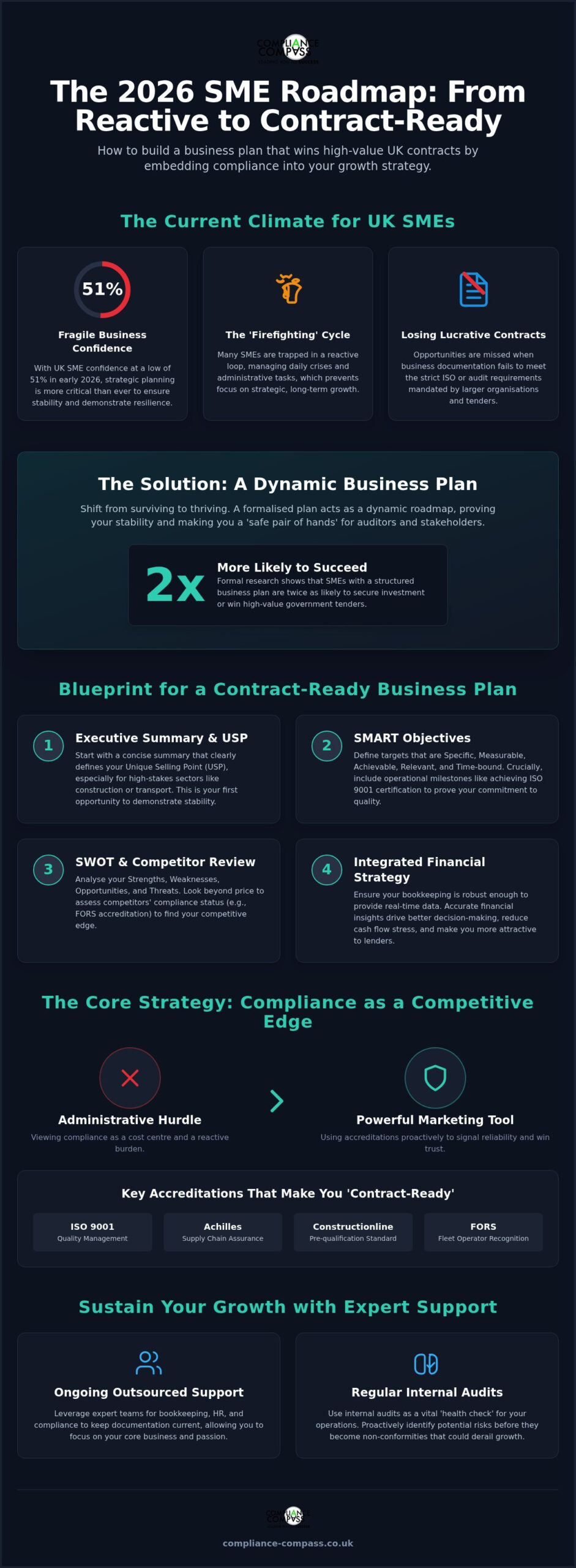
With UK SME confidence dipping to 51% in early 2026, it’s easy to feel that a formal SME business plan is a luxury you can’t afford. You likely started with a vision for growth, yet now find yourself trapped in a cycle of “firefighting” whilst managing administrative hurdles. It’s frustrating to watch lucrative UK contracts slip away because your documentation doesn’t meet the latest ISO or audit requirements. We know that the pressure of Companies House reforms and Making Tax Digital deadlines can feel overwhelming for any busy team.
This guide helps you regain control and move from being reactive to being contract-ready. You’ll learn how to structure a professional roadmap that integrates compliance and streamlined bookkeeping into your strategy, providing a clear 24-month path that satisfies auditors and secures your sustainable future. We will explore how to transform these regulatory burdens into a competitive advantage that drives long-term success.
Key Takeaways
- Discover how a robust SME business plan acts as a dynamic roadmap, moving your company beyond daily survival and towards long-term strategic growth.
- Learn to structure your plan with a focus on operational success, ensuring your executive summary clearly defines your competitive edge in the transport or construction sectors.
- Understand how to integrate compliance standards like ISO 9001 and Achilles as core growth drivers rather than administrative hurdles.
- Identify the practical steps needed to make your business audit-ready and attractive to major organisations for high-value UK contracts.
What is an SME Business Plan and Why is it Essential in 2026?
A robust SME business plan is far more than a static document used to secure an initial bank loan. In 2026, it serves as a dynamic business plan that outlines your company’s objectives whilst detailing the operational systems needed to maintain compliance. Modern plans must go beyond basic financial projections; they need to include clear roadmaps for meeting national standards like Constructionline or ISO 9001. This level of detail transforms your business from a surviving entity into a contract-ready partner for larger organisations.
Securing growth in the current climate requires tangible proof of stability. Research shows that SMEs with a formalised plan are twice as likely to secure investment or win high-value government tenders. With UK SME confidence sitting at 51% in early 2026, having a structured strategy provides the safe pair of hands that auditors and stakeholders look for. It’s about demonstrating that you’ve anticipated risks and organised your resources effectively. This preparation removes the barriers that often stop smaller firms from bidding for lucrative public sector work.
Establishing SMART Objectives for Sustainable Growth
Vague goals like “growing sales” won’t suffice in a competitive market. Instead, use the SMART framework to define targets that are Specific, Measurable, Achievable, Relevant, and Time-bound. Align these with the UK “Backing Your Business” initiative to leverage available government support and grants. Crucially, ensure your goals include operational milestones, such as achieving ISO 9001 support. These milestones prove your commitment to quality and provide a streamlined path to winning bigger UK contracts within the next 12 to 24 months.
How to Structure Your Business Plan for Operational Success
A professional SME business plan should be concise and outcome-focused. It acts as a “safe pair of hands” for your daily management, providing a clear reference point when decisions become complex. Start with a sharp executive summary that defines your Unique Selling Point (USP), particularly if you operate in the high-stakes construction or transport sectors. This summary is your first chance to prove that your operations are stable, organised, and ready for growth.
Integration of your financial strategy is vital. You need to ensure your bookkeeping support is robust enough to provide real-time data. When you write a business plan, focus on how these financial insights will drive your 2026 decision-making. Having accurate figures at your fingertips reduces the stress of cash flow management whilst making you more attractive to lenders.
Conducting a SWOT Analysis and Competitor Review
Identify your internal Strengths and Weaknesses alongside external Opportunities and Threats to find genuine gaps in the market. Don’t just analyse competitors on price. Instead, look at their compliance status. Holding a FORS accreditation can be a powerful differentiator that sets you apart from less organised rivals. This analysis allows you to refine your marketing strategy, positioning your SME as a low-risk, high-quality partner for major UK contractors. If you’re unsure where to start, our team can help you develop the business systems needed to support this strategic shift.
Integrating Compliance and Accreditation as a Growth Strategy
Stop viewing compliance as an administrative hurdle. It’s a core component of your SME business plan. Larger organisations in construction and infrastructure demand high standards. They often require suppliers to hold Achilles accreditation before they’re even allowed to tender for work. By building these standards into your strategy, you’re “contract-ready” from day one. You won’t be scrambling to meet requirements when a major opportunity suddenly appears on your radar.
Whilst the SBA guide to writing a business plan provides an excellent baseline for general structure, your SME business plan must address specific local supply chain demands. This proactive approach transforms compliance from a cost centre into a powerful marketing tool. It signals to potential partners that your business is stable, reliable, and deeply professional. Understanding your tender compliance requirements in detail is essential to ensuring no expired certificate or missing document stands between you and a high-value contract.
Leveraging Professional Support to Maintain Your Plan
A plan is only as good as the systems that support it. You might find that ongoing outsourced support is the most efficient way to keep your documentation current. Regular internal audits act as a vital health check for your operations. They identify potential risks before they become non-conformities that could derail your strategic growth.
Outsourcing these complexities allows you to focus on your core passion. You can lead your team whilst experts manage the intricate details of HR, bookkeeping, and transport compliance. This balanced approach ensures your business remains audit-ready and scalable throughout 2026. It’s about removing barriers so you can bid for bigger contracts with total confidence. Pairing this support with a structured approach to business process improvement for SMEs can eliminate the admin waste that quietly erodes your team’s productivity and tender success rate.
Build a Contract-Ready Future for Your Business
A robust SME business plan is your most powerful tool for transitioning from daily firefighting to strategic growth. By setting SMART objectives and integrating compliance standards like ISO 9001 and Constructionline directly into your operations, you prove to major contractors that you’re a low-risk partner. This proactive approach ensures you’re ready for the 2026 regulatory landscape whilst keeping your team focused on delivery.
AA Compliance Compass provides the safe pair of hands you need to navigate these requirements. With over 15 years of industry expertise, we specialise in making firms auditor-ready through pragmatic, hands-on support. We manage the complexities of bookkeeping, HR, and ISO standards so you can lead with confidence.
Contact AA Compliance Compass today to make your SME contract-ready
Start building a business that doesn’t just survive but thrives in the competitive UK market.
Frequently Asked Questions
How often should an SME update its business plan?
You should review your SME business plan at least once a year to ensure it remains aligned with your growth targets. However, significant regulatory changes in 2026, such as new Making Tax Digital requirements or Companies House reforms, may necessitate more frequent updates. Regular internal audits can help identify when your strategy needs adjusting to maintain compliance and operational efficiency.
Do I need a business plan if I am not looking for a bank loan?
Absolutely. An SME business plan is a vital operational tool that goes far beyond securing finance. It acts as a roadmap for achieving standards like ISO 9001 or Constructionline, which are often prerequisites for winning high-value UK contracts. Having a structured plan ensures your team stays focused on strategic milestones whilst maintaining the robust documentation required by auditors and major supply chain partners.
Can I outsource the creation and maintenance of my business systems?
Yes, you can outsource these functions to experts who specialise in business systems support. This approach allows you to implement secure, audit-ready platforms like Microsoft Sharepoint whilst freeing up your time to focus on core revenue-generating activities. Professional support ensures your documentation remains organised and compliant with current UK legislation, reducing the administrative burden on your internal staff and lowering overall business risk.
Disclaimer
This article is for general information only and does not constitute legal, financial or professional advice. Requirements may vary, so please seek advice appropriate to your circumstances. AA Compliance Compass Ltd accepts no liability for actions taken based on this content.