ISO Certification Journey for SMEs: A Practical Roadmap to Success
ISO certification isn’t a badge reserved for the corporate elite; it’s the operational engine that keeps small businesses competitive. You’ve likely felt that the volume of documentation might drown your team, or worried that a single audit mistake could derail your hard work. It’s a common concern that these standards are only for large corporations with endless resources. We understand that pressure. Your ISO certification journey for SMEs should be a path to growth, not a source of stress.
In this article, you’ll discover the exact steps to simplify compliance and ensure you’re contract-ready for 2026. We’re breaking down the process into a manageable roadmap, giving you the confidence to pass your audit and start tendering for the larger projects that will transform your business. By focusing on practical application over paperwork, you can build a stable foundation for long-term success.
Key Takeaways
- Understand why achieving “contract-ready” status is vital for UK businesses looking to win larger tenders and secure stable partnerships.
- Explore the 5-stage ISO certification journey for SMEs to help you move from initial gap analysis to a successful final audit with confidence.
- Learn how to organise your management systems and documentation efficiently, ensuring you meet international standards without creating excessive administrative burdens.
- Discover how to manage surveillance audits and foster a culture of continuous improvement to ensure your business remains compliant and competitive.
Navigating the ISO Landscape: Why SMEs are Prioritising Compliance
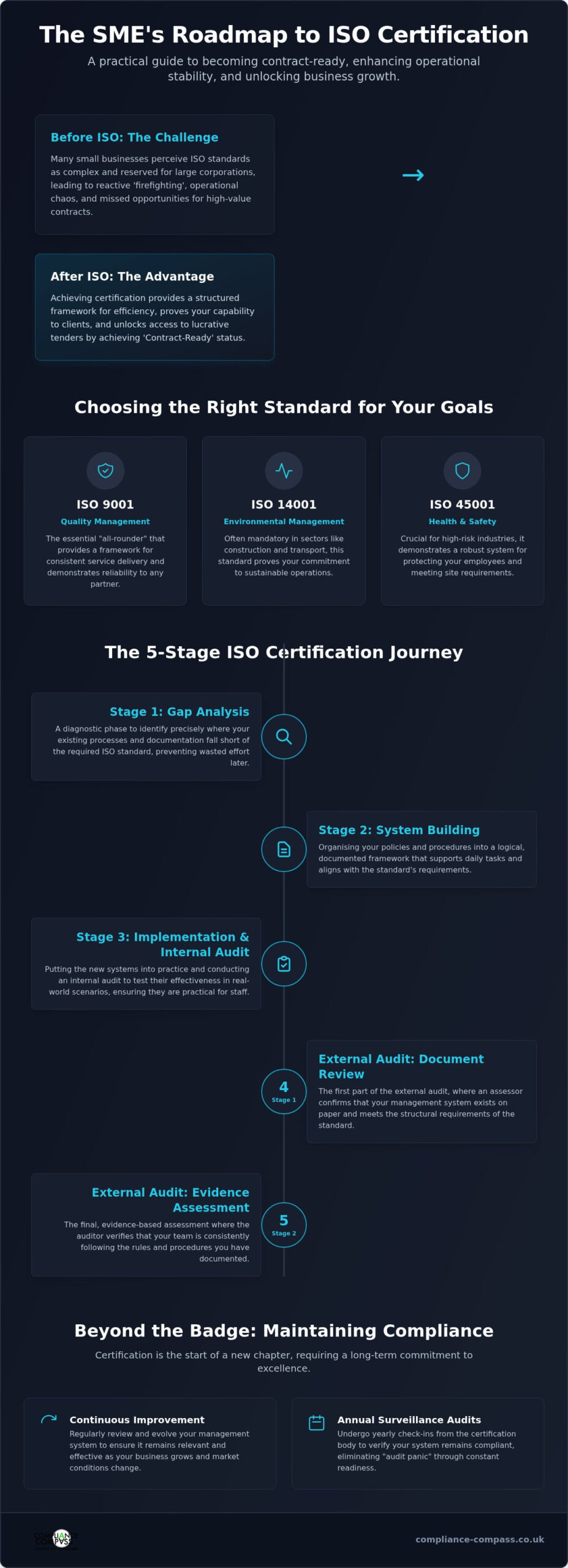
The ISO certification journey for SMEs is a structured roadmap designed to align your internal management systems with globally recognised best practices. It’s about moving away from reactive firefighting and towards a culture of stability and order. By adopting these frameworks, you replace confusion with a logical, step-by-step approach to business management. This transition ensures your operations are consistent, efficient, and ready for expansion.
Many UK organisations now operate a strict “Contract-Ready” policy. This means they won’t even consider a supplier for a tender unless they can prove compliance with specific international standards. Without these credentials, you’re often locked out of lucrative public sector and high-tier private contracts before the conversation even starts. Achieving certification proves you have the discipline to meet high-level requirements.
Whilst the process can feel daunting, it’s vital to remember that the ISO 9000 family of standards is built to be scalable. It isn’t just for the giants; it’s a tool for smaller teams to work smarter. ISO 9001 serves as the foundational quality management system for UK small businesses, providing a clear framework for consistent service delivery.
Choosing the Right Standard for Your Business Goals
Selecting your first standard depends on your industry’s specific demands and your long-term objectives. ISO 9001 is the essential “all-rounder” that demonstrates your reliability to any potential partner. If you work in construction or transport, you’ll likely find that ISO 14001 for environmental management and ISO 45001 for health and safety are becoming mandatory requirements for most sites. You can find more detail in our ISO 9001 Requirements UK: Practical SME Guide for 2026. These standards don’t just add paperwork; they remove barriers to growth by proving your operational maturity.
The 5-Stage ISO Certification Journey: A Roadmap for Small Businesses
The ISO certification journey for SMEs begins with a clear-eyed look at your current operations. Stage 1 is the Gap Analysis; this is where we identify exactly where your existing processes fall short of the required standard. This diagnostic phase prevents wasted effort later. Once the gaps are clear, you move to Stage 2: Documentation and System Building. This isn’t about creating “paperwork for paperwork’s sake.” Instead, it’s about organising your policies into a logical framework that supports your daily tasks.
Following this, Stage 3 involves Implementation and Internal Audit. You’ll test your new systems in real-world scenarios to ensure they’re practical for your staff. These international standards on quality management only work if they’re actually used. The final External Audit is itself a two-part process. Stage 1 is a “document review” to confirm your system exists on paper; Stage 2 is the “evidence-based” assessment to prove you’re actually following your own rules.
Preparing for the External Audit with Confidence
When the external auditor arrives, transparency is your best asset. They aren’t looking for perfection; they’re looking for consistent, “business as usual” behaviour. Having professional support means you have “in-house auditors for the auditors” by your side to handle technical queries. Our latest documentation, Version 001, dated 7/7/2026, ensures your approach aligns with current expectations. If you’re feeling overwhelmed by the paperwork requirements, exploring dedicated ISO 9001 documentation support can help you build a system that works for your team rather than against it. You can also reach out for a guiding hand to simplify your path to certification.
Beyond the Badge: Maintaining Compliance and Driving Growth
Receiving your certificate is a major milestone. However, it’s actually the start of a new operational chapter. The ISO certification journey for SMEs requires a long-term commitment to continuous improvement. You don’t just “get certified” and stop. You evolve. Regular reviews ensure your management system stays relevant as your business grows and changes. This ongoing attention prevents the framework from becoming a stagnant set of rules.
To keep your status, you’ll face annual surveillance audits. These are check-ins by the certification body to verify that your system remains effective. Many businesses fall into the trap of “audit panic” a month before the assessor arrives. Ongoing support eliminates this stress. By keeping documentation and internal audits up to date throughout the year, the external visit becomes just another day at the office. You stay ready, always.
An organised business centre does more than just win contracts. It improves staff wellbeing by providing clear roles and reducing the chaos of poorly defined processes. It also lowers operational risk. Potential issues are spotted and resolved before they become costly failures. This stability builds a stronger, more resilient company that is prepared for any market shift.
The Value of Independent Internal Audits
Independent reviews are vital because they identify risks that internal teams might overlook whilst focused on daily operations. It’s easy to miss a recurring error when you’re too close to the work. Using a gap analysis as a tool for growth allows you to find hidden efficiencies in your supply chain. If you want to ensure your systems are robust, Contact AA Compliance Compass for a professional readiness review. This proactive approach turns the ISO certification journey for SMEs into a genuine competitive advantage.
Securing Your Future with Operational Excellence
Your ISO certification journey for SMEs is more than a compliance exercise; it’s a strategic move to build a more resilient and efficient business. By following a structured roadmap, you’ve seen how to bridge operational gaps and prepare for external audits without the usual stress. Transitioning to a proactive, contract-ready organisation opens doors to high-value tenders that drive long-term expansion.
We provide the practical, hands-on support you need to succeed. With over 15 years of industry experience and deep expertise in ISO 9001, 14001, and 45001, we’re ready to manage the heavy lifting of documentation. Our goal is to ensure you pass your audit with calm confidence while we act as a safe pair of hands for your management systems.
Contact AA Compliance Compass today to start your ISO journey with confidence
Take the first step towards a more organised and competitive future today.
Frequently Asked Questions
How long does the ISO certification journey typically take for an SME?
The ISO certification journey for SMEs typically takes between three and six months to complete. This timeline depends on the complexity of your current operations and how much documentation is already in place. Whilst some smaller organisations can move faster, it’s vital to allow enough time for staff to adopt new processes naturally. This ensures the system is robust before assessment.
Do we need to hire a full-time compliance officer to get ISO certified?
No, you don’t need to hire a full-time compliance officer to achieve certification. Many small businesses find that outsourcing this function is a far more cost-effective alternative. By using professional support, you gain access to expert guidance without the overhead of a permanent salary. This approach allows your existing team to focus on core activities whilst we handle the heavy lifting.
What is the difference between an internal audit and an external certification audit?
An internal audit is a proactive review conducted by your team or an independent consultant to identify risks and improvements. It serves as a practice run to ensure your systems work effectively. In contrast, an external certification audit is performed by an independent body to verify compliance. This assessment is what officially awards your certificate and confirms you meet international standards.
Can an SME achieve ISO 9001, 14001, and 45001 at the same time?
Yes, SMEs can definitely achieve ISO 9001, 14001, and 45001 simultaneously through an Integrated Management System. Combining these standards reduces duplication and simplifies your documentation. It’s often more efficient to tackle them together, as many requirements overlap. This streamlined approach ensures your ISO certification journey for SMEs is both cost-effective and less disruptive to your daily operations.
Disclaimer
This article is for general information only and does not constitute legal, financial or professional advice. Requirements may vary, so please seek advice appropriate to your circumstances. AA Compliance Compass Ltd accepts no liability for actions taken based on this content.