SME Grant Applications: The 2026 Guide to Securing UK Business Funding
For many UK small and medium-sized enterprises (SMEs), securing the right funding is the critical step that unlocks growth, innovation, and resilience. The landscape of business finance can seem complex, with a mix of non-repayable grants and various loan options available. Understanding the differences and preparing your business properly are the keys to a successful application.
Navigating this process requires more than just a good idea; it demands a clear strategy, meticulous preparation, and a deep understanding of what funders are looking for. Whether you are aiming for a government grant to fund a green energy project or a government-backed loan to manage cashflow, the principle is the same: you must prove your business is a well-managed, financially sound investment with a clear plan for the future.
This guide for 2026 breaks down the essential steps for SME grant and loan applications, helping you to position your business for success and secure the capital you need to thrive.
Understanding UK Business Funding in 2026: Grants vs. Loans
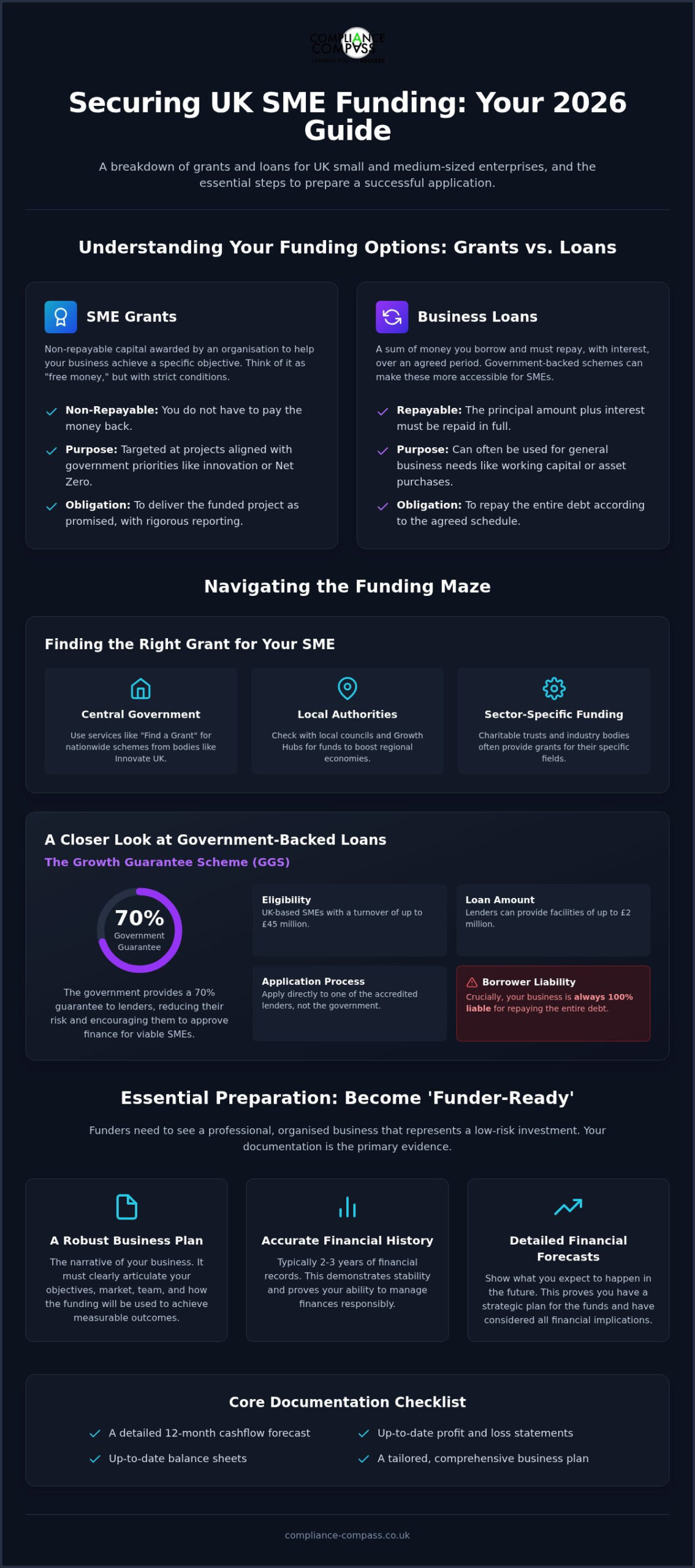
Before beginning your search, it is vital to understand the two primary routes for business funding: grants and loans. While both provide capital, they function in fundamentally different ways and are suited to different business needs.
- SME Grants: A grant is non-repayable capital awarded by a public body or organisation to help a business achieve a specific objective. Think of it as “free money,” but with very strict conditions. Grants are typically targeted at projects that align with government priorities, such as innovation, transitioning to Net Zero, creating jobs in specific regions, or driving digital transformation. Whilst you do not have to pay the money back, you are legally obligated to use it for the stated purpose and will face rigorous reporting and audit requirements.
- Business Loans: A loan is a sum of money that you borrow and must repay, with interest, over an agreed period. Unlike grants, loans can often be used for more general business purposes like working capital or asset purchase. For many SMEs, government-backed schemes like the Growth Guarantee Scheme or dedicated Start Up Loans can be more accessible than traditional bank lending, as the government provides the lender with a degree of security.
The key difference lies in obligation. With a grant, the obligation is to deliver the project as promised. With a loan, the obligation is to repay the debt in full.
Navigating the Funding Maze: From Grants to Government-Backed Loans
Once you are clear on the type of funding you need, the next step is to find the right scheme. The UK offers a wide array of options, but they are often highly specific and competitive.
Finding the Right Grant for Your SME
Grant funding is fragmented across different bodies, each with its own remit and priorities. Key sources include:
- Central Government Schemes: The government’s “Find a Grant” service is a useful starting point for discovering funds available directly from departments like Innovate UK, which focuses on research and development.
- Local Authorities and Growth Hubs: Many local councils and Local Enterprise Partnerships (LEPs) offer smaller, localised grants aimed at boosting regional economies, supporting specific local industries, or encouraging job creation.
- Sector-Specific Funding: Charitable trusts and industry bodies often provide grants for businesses operating in their specific field, from creative arts to environmental technology.
The challenge with grants is the specificity of the eligibility criteria. An application that does not perfectly align with the fund’s objectives will be rejected immediately, making it crucial to research each opportunity thoroughly.
A Closer Look at Government-Backed Loans: The Growth Guarantee Scheme
For businesses that need funding for growth, investment, or working capital, a government-backed loan is often a more suitable option. The Growth Guarantee Scheme (GGS), which succeeded the Recovery Loan Scheme, is a key pillar of this support in 2026.
It is important to understand that the GGS is not a direct loan from the government. Instead, the government provides a 70% guarantee to accredited lenders on loans to SMEs. This reduces the lender’s risk, making them more likely to approve finance for viable businesses.
Key features of the Growth Guarantee Scheme include:
- Eligibility: It is open to UK-based SMEs with a turnover of up to £45 million.
- Loan Amount: Lenders can provide facilities of up to £2 million.
- Application Process: You do not apply to the government. You apply directly to one of the accredited lenders participating in the scheme.
- Borrower Liability: Despite the government guarantee to the lender, your business is always 100% liable for repaying the entire debt.
The GGS is a powerful tool for accessing debt finance, but like any loan, it requires a compelling business case and strong financial evidence to secure.
Essential Documentation: Preparing Your Application for Success
Whether you are applying for a highly competitive grant or a government-backed loan, funders are looking for the same thing: a professional, organised, and “funder-ready” business. They need to see that you are a low-risk investment capable of managing public or private funds responsibly. Your documentation is the primary evidence of this.
A rushed or incomplete application is the fastest way to get a rejection. Before you even begin writing, you must have your core business documents in order. This includes:
- A Robust Business Plan: This is the narrative of your business. It must clearly articulate your objectives, your market, your team, and how the funding will be used to achieve specific, measurable outcomes. Your plan should be tailored to align with the goals of the specific grant or loan. Find out more about how to write a robust SME business plan here.
- Accurate Financial History: Most funders will require at least two to three years of financial records. This demonstrates stability and your ability to manage finances. Professional and accurate bookkeeping is not a luxury; it is a fundamental requirement.
- Detailed Financial Forecasts: You must show what you expect to happen in the future. This proves you have a strategic plan for the funds and have considered the financial implications.
The Core Documentation Checklist
Having your documents ready not only speeds up the application process but also shows the funder that your business is professionally managed. Your checklist of non-negotiables should include:
- A detailed 12-month cashflow forecast.
- Up-to-date profit and loss statements and balance sheets.
- Business bank statements for the last 6-12 months.
- Proof of PAYE and VAT compliance from HMRC.
- A full list of company assets and any existing liabilities or debts.
Storing these documents in centralised and secure business systems ensures they can be retrieved and shared quickly and professionally during the due diligence and audit phases, reinforcing the impression of a well-organised operation.
Securing funding is a significant undertaking, but it doesn’t have to divert you from the essential task of running your business. By focusing on preparation and organisation, you can confidently demonstrate that your SME is a worthy recipient of investment.
At AA Compliance Compass, we specialise in making SMEs funder-ready. We manage the complex application process for grants and government-backed loans from start to finish, ensuring your documentation is robust, your business case is compelling, and your application has the best possible chance of success.
- Over 15 years of industry experience leading businesses to success
- Specialists in making SMEs contract-ready for major UK tenders and grants
Contact AA Compliance Compass for expert support with your grant or loan application and let us handle the paperwork while you focus on growth.
Frequently Asked Questions (FAQs)
What is the most common reason for SME grant applications being rejected?
The most common reasons are a failure to meet the strict eligibility criteria and a weak business case. Many applications are rejected because the project does not perfectly align with the grant’s stated objectives. Others fail because the business plan is unclear, the financial forecasts are unrealistic, or the application is missing key documents, suggesting a lack of organisation.
How long does the SME grant or loan application process typically take in the UK?
The timeline varies dramatically depending on the scheme. Simple, small local grants might take a few weeks. Larger, more complex government grants, especially for innovation (like those from Innovate UK), can take many months from expression of interest to the final decision. Government-backed loans depend on the lender’s internal processes but can often be quicker, typically taking several weeks once all documentation is submitted.
Can I apply for multiple grants or loans at the same time for my business?
Yes, you can apply for multiple sources of funding simultaneously. However, you must be transparent. Most grant providers will ask about other funding you have applied for or secured for the same project, as they want to avoid “double-funding.” It is crucial to have a clear strategy and be prepared to explain how the different funding streams would complement each other without overlap.
Is the Growth Guarantee Scheme a grant?
No, it is not a grant. The Growth Guarantee Scheme is a loan guarantee programme. The government guarantees 70% of the loan amount to the lender, not to you. Your business is still responsible for repaying 100% of the loan plus interest. It is a form of debt finance designed to make it easier for SMEs to secure loans from commercial lenders.
Document Version: 001. Document Date: 7/7/2026.
Disclaimer
This article is for general information only and does not constitute legal, financial or professional advice. Requirements may vary, so please seek advice appropriate to your circumstances. AA Compliance Compass Ltd accepts no liability for actions taken based on this content.